
Man Tracks?
A Summary of the Paluxy "Man Track" Controversy
Copyright © 1992 - 2010 by
Glen J. Kuban
[This article is being mirrored from http://paleo.cc/paluxy/mantrack.htm.]

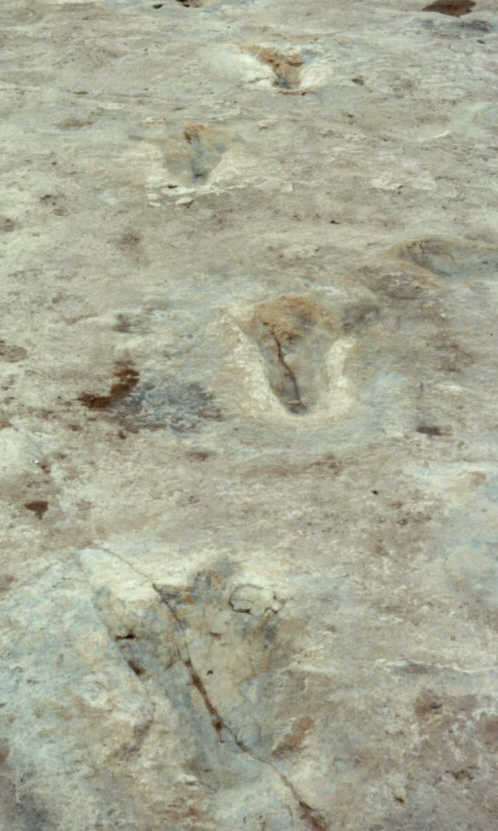 |
| Taylor Trail, west end, 1984. Track IIS,+2 at bottom. Note anterior splaying and indications of a tridactyl digit pattern. |
 |
| These and other alleged human tracks on the "State Park Shelf" are erosional features, often selectively moistened to encourage human-like shapes. |

|
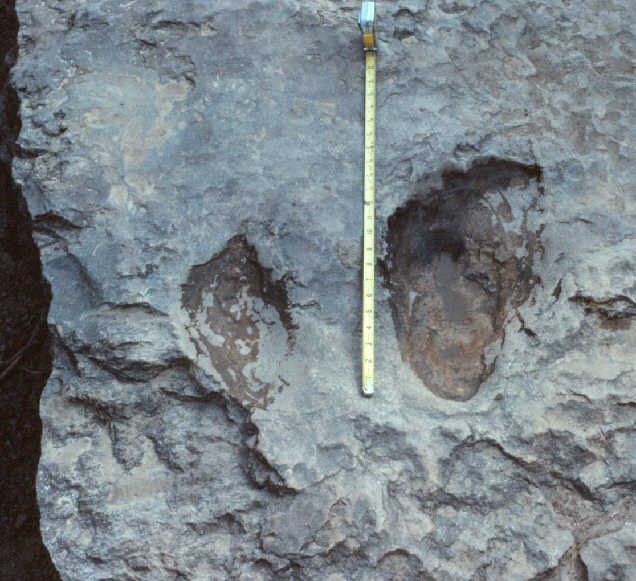
| "The Burdick Slabs" on loose blocks of limestone. Each print is about 15 inches long and shows very unnatural features, especially in the toes and bottom contours. Photo by Clifford Burdick, c. 1950. |
However, initial critical work in the early 1970's (Neufeld, 1975), and more intensive scientific studies in recent years, have convincingly refuted the "man track" claims, and led to their abandonment even by most creationists. The alleged human tracks involve a variety of phenomena, including elongate dinosaur tracks, erosional features, indistinct markings of unknown origin, and a few carvings.
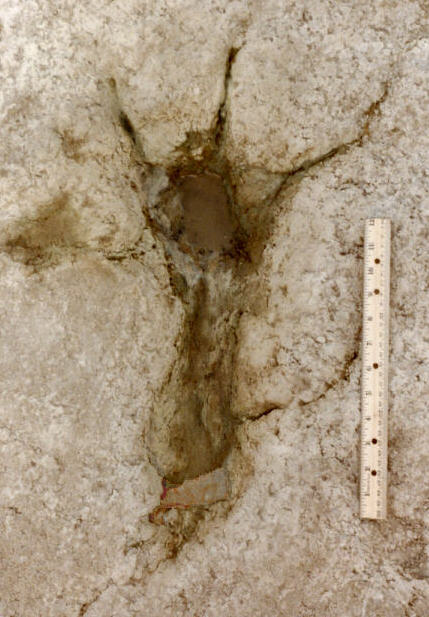 |
| Distinct metatarsal track at Alfred West site. |
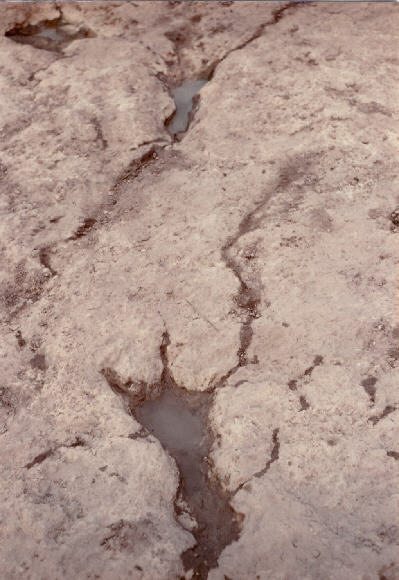 |
| Trail of metatarsal tracks on Al West site. |
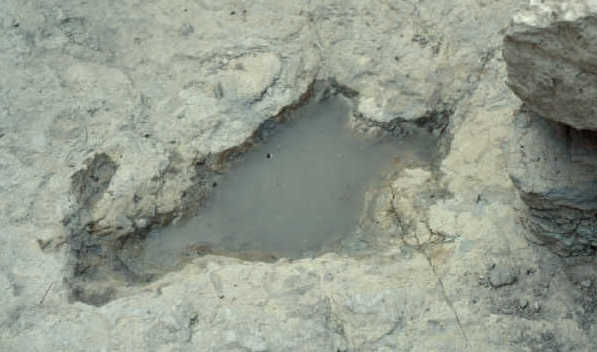 |
| "Baughanthropus Site", 1982. A dinosaur track with partial metatarsal impression, promoted by Baugh as a human track overlapping a dinosaur track. |
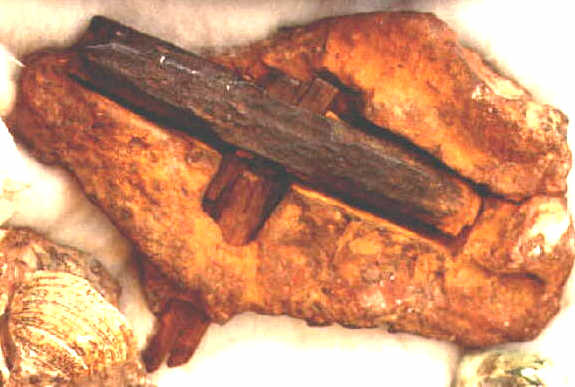 |
| The "London Artifact"--an alleged Cretaceous hammer. |
|
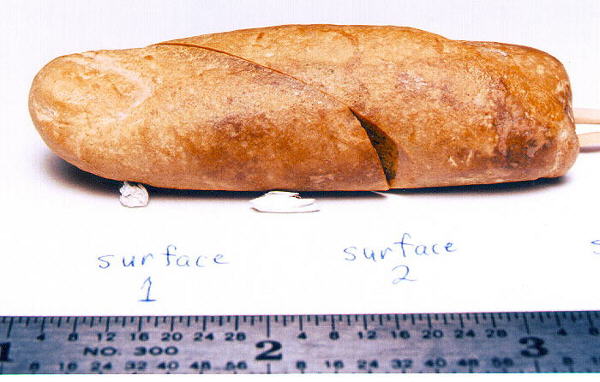
| Alleged Cretaceous finger |
The Taylor Site. This was Paluxy site most often claimed to contain human tracks, beginning with Stanley Taylor's research and film in the late 1960's and early 1970's (Taylor, 1973), and continuing with other claims throughout the 1970's and 1980's. However, the most thorough analyses indicate that the alleged human tracks here are elongate, metatarsal dinosaur tracks--made by dinosaurs that, at least at times, impressed their soles and heels as they walked (Kuban, 1986a, 1986b; Hastings, 1988)). When the digit marks of such tracks (which are common in the Paluxy Riverbed) are subdued by one or more factors (erosion, sediment infilling, or mud-collapse), they often resemble giant human prints. Most of the tracks on the Taylor Site are largely infilled with a secondary sediment which hardened into the original track depressions. When the tracksite surface is well cleaned, at least some tracks in each trail show shallow tridactyl (three-toed) digit impressions indicating dinosaurian origin, as as well as color and texture distinctions corresponding to the infilled material and further confirming the dinosaurian nature of the tracks (Kuban, 1986b; Hastings, 1978a). Claims during the 1990's by Carl Baugh and associates that some of these tracks have human prints within them or overlapping them have been shown to be as baseless as the original claims.(Kuban, 1989).
A site largely ignored by the human track advocates but which has great relevance to the controversy is the Alfred West site, just a stone's throw from Carl Baugh's Creation Evidence Museum. At the West site are numerous striding trails of dinsosaur tracks, including several metatarsal trackways. In some of these trails one can see both clear metatarsal tracks with three distinct dinosaurian digits, as well as less distinct (due to erosion or mud collapse of the digits), somewhat more human-like metatarsal tracks in line with them. Such tracks are very similar in size and have the same general proportions as the renown "man tracks" at the Taylor Site (which again, are largely infilled metatarsal dinosaur tracks).
State Park Ledge. This shelf, situated above the main track layer in Dinosaur Valley State Park, is across the river from the north-west parking lot. A variety of supposed "man tracks" here were first publicized by Stanley Taylor and crew in the late 1960's, and were subsequently advocated by other "man track" enthusiasts.(Bierle, 1977, Dougherty, 1979). Included were some alleged striding trackways, child prints, and even a supposed bear print. However, careful analysis of the supposed prints here indicates that they are merely natural irregularities and erosional features of the substrate. None show a clear and natural suite of human features (especially in regards to bottom contours), and the alleged striding trails do not show consistent human-like stride patterns. Many past "man track"advocates had applied water, oil, or other substances to the markings to encourage the appearance of human shapes; however, without selective highlighting none show clear human features.(Farlow, 1987; Kuban, 1986a)
The Baugh/McFall Sites. In the late 1960's and 1970's one trail on this ledge was considered human by a some workers (Taylor, 1968), but later acknowledged by other creationists to consist of eroded, elongate dinosaur tracks (Morris, 1980). Since 1982 several other sites along this ledge have been excavated by Carl Baugh and associates, who claimed many other "man tracks" there (Baugh, 1982, 1987). However, rigorous studies have failed to support such claims. The alleged human tracks on these sites involve several phenomena, including elongate dinosaur tracks and parts thereof; indistinct elongate marks of unknown origin that were not in striding trails; shallow, vague markings in the rock surface or overlying marl; invertebrate trace patterns, and some markings with evidence of deliberate alteration (Cole and Godfrey, 1985).
Alleged Human and Cat tracks loose rocks. Some loose blocks of rock with human or cat-like prints, reputed to have come from Glen, first appeared during the late 1930's. These tracks were once promoted as genuine by a number of creationists (Burdick, 1950; Morris and Whitcomb, 1961). However, anatomic problems with the prints, knowledge of past carving practices in Glen Rose, and problematic cross-sectional features, lead most researchers, even among creationists, to reject their authenticity (Neufeld, 1975). An exception is Carl Baugh, who continues to advocate a number of "man tracks" on loose slab, inclujding the "Burdick Track" and the "Alvis Delk Footprint." However, neither is convincing. The Brurdick print not only involes the problems mentioned above, but also evidence from algal features in cross sections that the putative human print was carved on what was originally the bottom of the slab (Kuban and Wilkerson, 1989). The Delk print, like the Burdick track, was not documented in situ, and contains a number of anatomic problems. CT scans claimed to demonstrate its authenticity involve serious inconsistencies (Kuban, 2008).
Other Loose Fossils and Artifacts. Among other objects claimed by a few to represent "out-of-order" fossils are an alleged human tooth, a supposed Cretaceous trilobite, a hammer, and a "human finger." The tooth, found in the Paluxy in 1987, has been conclusively shown to be a fish tooth (Hastings, 1987b). The trilobite, reportedly found decades ago in the Paluxy, was not documented in place, and cannot be linked reliably to the riverbed strata (Hastings, 1986, 1987). The hammer, reportedly from a paleozoic formation near London, Texas, is encased in a concretion (found loose rather than in situ), and thus may be unrelated to the age of the host rock (Cole, 1985; Kuban, 1997). The alleged human finger is inconsistent with preservational features of Cretaceous fossils in Texas, and shows a number of anatomoic problems. Moreover, Baugh hiself has acknowledged that it was found loose on a gravel bed. Thus, even if it were a real fossil finger, since it is not reliably linked to an ancient formation, it is of no anti-evolutionary value. Other Texas fossils and artifacts have been claimed by Baugh and others to be "out-of-order" but also are not well supported. Even major creationist groups such as "Answers in Genesis" consider them dubious and recommend that they not be used as anti-evolutionary evidence.
Conclusions. Although genuine dinosaur tracks are abundant in Texas, claims of human tracks have not withstood close scientific scrutiny, and in recent years have been largely abandoned even by most creationists. Alleged Paluxy "man tracks" involve a variety of spurious phenomena, including metatarsal dinosaur tracks, erosional features, indistinct markings of unknown origin, and a few loose carvings.
* The term "dinosaurs" is used here in the traditional sense, that is, excluding birds. This caveat must be made in that many scientists now classify birds (using cladistic taxonomy) as essentially feathered theropod dinosaurs. In other words, the term dinosaurs in this article refers to non-avian dinosaurs.
Note: Many sites outside Dinosaur Valley State Park are on or alongside private property. Permission should be secured from the respective land owners and managers before visiting such sites. Also, no excavation or other disturbance of tracks in the Paluxy, beyond light sweeping or brushing to clean them, may be conducted without written permission of the appropriate authorities, including the Texas Department of Parks and Wildlife, and inside Dinosaur Valley State Park, the park superintendent.
Beierle, Fred, 1977, Man, Dinosaurs, and History, Prosser, WA: Perfect Printing Co.
Dougherty, Cecil N., 1979 (sixth edition), Valley of the Giants, Bennett printing Company, Cleburne, TX.; see also ref. 10. Numerous other publications during the 1970's and 1980's also promoted "man track" claims.
Baugh, Carl E., 1982, Enemies Survived Together for A While (video Tape), Creation Evidences Museum, Glen Rose, TX; Baugh,
Carl, Baugh, 1987, Dinosaur, Promise Publishing, Orange, CA. Baugh's claims are also repeated in newsletters and tapes distributed by his Creation Evidences Museum.
Burdick, Clifford C., "When Giants Roamed the Earth," Signs of the Times, July 25, 1950; Morris, Henry M., and John C. Whitcomb, 1961, The Genesis Flood, Baker Book House: Grand Rapids, MI, pp. 173-175.
Cole, John C., 1985, If I Had a Hammer, Creation/Evolution, Issue XV, Vol.5, No. 1, pp. 46-47.
Cole, John R., and Laurie R. Godfrey, eds., 1985, Creation/Evolution, Issue 15, Vol. 5, No. 1, pages 16-21
Farlow, James O., 1987, Lower Cretaceous Dinosaur Tracks, Paluxy River Valley, Texas, SCGSA, Waco, Tx. Also ref. 6, 12.
Hastings, 1986, Tracking Those Incredible Creationists: The Trail Continues, Creation/Evolution, Issue XVII, pp. 19-27.
Hastings, 1987a, Tracking Those Incredible Creationists: The Trail Goes On, Creation/Evolution, Issue XXI, pp. 30-42.
Hastings, Ronnie J., 1987b, Creationists' "Glen Rose Man" Proves to be a Fish Tooth (as Expected) , NCSE Reports, Vol. 9, No. 3, pp. 14-15.
Hastings, Ronnie J., 1987, New Observations on Paluxy Tracks Confirm Their Dinosaurian Origin, Journal of Geological Education, Vol. 35, No. 1, pp. 4-15.
Hastings, Ronnie J., 1988, Rise and Fall of the Paluxy Man Tracks, Perspectives on Science and Christian Faith (Journal of the ASA), Vol. 40, No. 3, pp. 144-155.
Kuban, Glen, 1986a, The Taylor Site "Man Tracks," Origins, Vol. 9, No. 1, pp. 1-9.
Kuban, Glen, 1986b, Elongate Dinosaur Tracks, In: Gillette, David D. and Martin G. Lockley, eds., Dinosaur Tracks and Traces, 1989, Cambridge University Press, Cambridge, pp. 57-72.
Kuban, Glen, 1986c, Color Distinctions and Other Curious Features of Dinosaur Tracks Near Glen Rose, Texas, In: Gillette, David D. and Martin G. Lockley, eds., Dinosaur Tracks and Traces, 1989, Cambridge University Press, Cambridge, pp. 427-440;
Kuban, Glen J., 1989, Retracking Those Incredible Man Tracks, NCSE Reports, Vol. 9, No. 4, Special Section.
Kuban, Glen J. and Gregg Wilkerson, 1989, The Burdick Print, Web article at http://paleo.cc/paluxy/wilker5.htm.
Kuban, 1997. The London Hammer: An Alleged Out-of-Order Artifact, web article at http://paleo.cc/paluxy/hammer.htm.
Kuban, Glen, 2008, The Delk Footprint, web article at: http://paleo.cc/paluxy/delk.htm.
Morris, John D. 1980, Tracking Those Incredible Dinosaurs, San Diego, CA, Creation-Life Publishers, pp. 134-136, 197-98.
Neufeld, Berney, 1975, "Dinosaur Tracks and Giant Men", Origins, Vol. 2, No. 2, pp. 64-76.
Taylor, Stanley E., 1973, Footprints in Stone (film), Films for Christ Association (Eden Films), Elmwood, IL (now Mesa, AZ).
Taylor, Stanley E., 1968, Search for Man Tracks in the Paluxy River, Films for Christ Special Report, October; Taylor, Stanley E., 1971, The Mystery Tracks in Dinosaur Valley, Bible Science Newsletter, Vol. 9, No. 4, pp. 1-7;
Paluxy website Page hits:
Updated: 03/2010; 9/2008; 7/2006; 12/2005
Revised: 05 Dec 2004, Added new Paluxy counter code