The reason for the
name change was the rules by which taxonomy operates. What
happened was two different fossils named by two different
paleontologists were later decided to belong to the same genus.
When this happens according to the rules of taxonomy the name
that was recorded in the scientific literature first get
priority.
In this case a partial skull found in England was named
Hyracotherium by Sir Richard Owen (who also coined the
name 'dinosaur') in 1840.
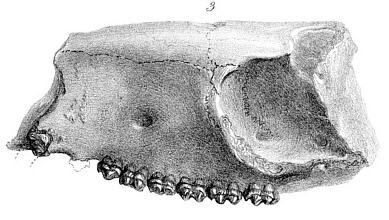
Owen's illustration of the first Hyracotherium
fossil found (Owen 1841).
Later in 1876 American paleontologist Othanial C. Marsh (who
named half the dinosaurs you've ever heard of) named a very
similar fossil Eohippus (Marsh 1876). It was obvious to
most paleontologists that these fossil were very similar but
since the originals were on different sides of the Atlantic ocean
it took some time for direct comparisons to be made. Finally in
1932 a third scientist, Sir Clive Forester Cooper, published a
paper demonstrating that the two fossil types were so similar
that placing them in separate genera could not be justified.
Thereafter according to the rules of taxonomy
Hyracotherium became the official name for all the fossils
and the name eohippus became what is called a junior synonym of
that genus.
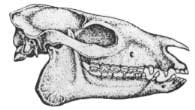
An illustration of a complete Hyracotherium
skull (Romer 1966).
A similar situation occurred with the dinosaur Apatosaurus
which was at one time known by its more popular, and evocative
name brontosaurus (which means "thunder-lizard"). Coincidentally
this case also involved O. C. Marsh, however in this case he
named both genera.
The current taxonomic rules for the naming of animals (fossil
and living) can be found in the International Code of
Zoological Nomenclature.
And now to relate this to the claims of
antievolutionists…
Owen's giving this fossil the name Hyracotherium (which
means hyrax-like beast) has led many antievolutionists to claim
that Hyracotherium either is hyrax or is at least
"practically identical" to a hyrax:
There are actually some very good technical reasons for
calling the so-called Eohippus (‘dawn horse’)
Hyracotherium. It is practically identical to a modern
Hyrax, which is why its discoverer, Richard Owen, gave it that
name. - Jonathan
Sarfati (from Answers in Genesis)
The claim that Hyracotherium either is a hyrax or is
even "practically identical" to a hyrax is patently false as
anyone who takes the time to compare the two can
easily see.
However if antievolutionists cannot be bothered to actually
compare Hyracotherium with hyraxes before claiming them to
be the same animal they certainly can't be bothered to read what
Owen said about naming this fossil Hyracotherium:
Without intending to imply that the present small
extinct Pachyderm was more closely allied to the Hyrax than as
being a member of the same order, and similar in size, I
propose to call the new genus which it unquestionably indicates,
Hyracotherium, with the specific name
leporinum.
The Order Owen is referring to here is "Pachydermata" (after
Cuvier) which is no longer considered a valid taxon. It included
elephants (obviously), even-toed ungulates (cows, deer etc.),
odd-toed ungulates (including horses), hippos, pigs, and the
hyraxes. So his placing Hyracotherium in the same order as
hyraxes wasn't really saying much for their being all that
similar.
Further evidence that Owen did not see a particularly close
resemblance between Hyracotherium and hyraxes came a few
years later when he wrote a paper in which he attempted to refine
Cuvier's classification of "Pachyderms". (Owen 1848) In this
paper Owen divided the ungulates up into three different groups,
the Proboscidia (elephants), the Artiodactyla (even- toed), and
Perissodactyla (odd-toed), and he gave a list of examples of each
of these, which is where it gets interesting.(ibid p.139)
In the list of Artiodactyls he lists Hyracotherium.
In the Perissodactyla he lists the hyrax (and of course the
horse).
So Owen placed Hyracotherium in one branch of the order
and hyraxes and horses in the other. If anything this would imply
that he thought hyraxes and horses were more similar to each
other than either was to Hyracotherium. He was wrong of
course, but again, all he had of Hyracotherium was a
crushed partial skull, so he can be forgiven. Modern
antievolutionists, on the other hand, have no excuse except
intellectual dishonesty.
References
- Forster-Cooper, C. (1932) "The Genus Hyracotherium. A
Revision and Description of New Specimens Found in England",
Philosophical Transactions of the Royal Society of London
B, 221:431-448
- Marsh, O. C. (1876) "Notice of new Tertiary Mammals", The
American Journal of Science and Arts, 12(71):401-404
- Owen, R. 1840 "Description of the fossil remains of a mammal,
a bird, and a serpent, from the London Clay." Proceedings of
the Geological Society of London, 3(66):162-166
- Owen, R. 1841. "Description of the Fossil Remains of a Mammal
(Hyracotherium leporinum) and of a Bird (Lithornis
vulturinus) from the London Clay." Transactions of the
Geological Society of London, Series 2, VI:203-208, 1
plate.
- Owen, Richard (1848) "Description of Teeth and portions of
Jaws of two extinct Anthracotheroid Quadrupeds (Hyopotamus
vectianus and Hyop. bovinus)..." The Quarterly Journal Of The
Geological Society Of London 4(1):103-141
- Romer, Alfred Sherwood (1966) Vertebrate Paleontology
(3rd Edition), p. 265.
Links