Feedback Compilation
Feedback for June 2003
Selected reader letters and TalkOrigins responses from June 2003.
Feedback Letter
Several times it is stated that creationism makes no testable predictions and is therefore not scientific.
My question is this. Imagine a universe, separate from ours, that IS created by someone (God, us, it doesn't matter). Further suppose that all the creatures within it are designed and set into motion (much like some creationists believe).
In such a universe, would it be possible at all for the intelligent creatures in it to describe the actual, true origins of their universe, or themselves, in a scientific manner? If not, is it really valid to fault creationism for being non-scientific?
(Please do not infer from my challenge on this point that I am a creationist; it is just an interesting question that I have as yet been unable to come up with a suitable answer for.)
Response
Now imagine World Two, in which the world is phenomenally exactly as we see it, but which was created and in which all things that seem to happen due to regularities, are actually caused by the direct but hidden intervention of God. Could we tell the difference? And the answer is quite simply, no. All the evidence would be telling us what we now infer from it in science - the world would look like it was of great age and all living things would look like they evolved.
Now we might hypothetically imagine World Three, in which things were as they were in World Two, except that they now looked like they had been created without common descent or great age. What sort of world would that be? It would, I suggest, be something like World One - things would be very different to the way they appear now. There would be evidence of floods worldwide; genetics would be different, there would be no evidence of living things appearing in related kinds but instead kinds would be either not related at all or related in some rational manner that explained the Mind of the Creator. And so on.
Since we do not live in Worlds One or Three, we may as well live in World Zero. There is no way we can make testable predictions for creationism if we live in Worlds Zero or Two. Creationism failed the tests it could have made when we did not know as much as we do now. So World Two, if it were true, would forever remain hidden from us in terms of learned knowledge. Hence if it is true, we do not know it.
A basic assumption of science is, take the path of least resistance when explainign things (more accurately, don't posit more entities and causes than you need to). If we can explain the observed world as if it were World Zero, then to claim it is World Two on purely scientific grounds, is simply bad science.
Feedback Letter
Feedback Letter
Response
Since you are not at all swayed by information from this site, I have provided for you a set of links to Christian sites which you may be more inclined to trust.
From Answers in Genesis: Have NASA's computers really proven a long day?
From Apologetics Press: Has NASA Discovered Joshua's "Lost Day"?.
From ChristianAnswers.NET; on these kinds of hoaxes in general: Another hoax that preys on the naivety of some Christians.
And for more background, from a source which is simply interested in the story as an example of an urban legend, see snopes The Lost Day.
Feedback Letter
Response
Your second defintion of theory simply does not apply. Using it would be like trying to apply the definition of a sand bar to a "bar" that sells drinks.
One does not need to witness something directly to consider it a fact. We have witnessed tons of evidence left by evolution (including directly witnessing a few cases of macroevolution). See 29+ Evidences for Macroevolution for a very brief summary of this evidence.
Finally, Creation is not a theory. It is a myth (in the sense of a sacred story, the original meaning of that term). It is not comparable to evolution.
Feedback Letter
I must say I was quite surprised that it's such a hot topic in the United States, which I've always viewed as a very advanced and intelligent country. Why are there still so many people (apparently) who don't accept evolution or the fact that the earth is several billion years old in the US? Is it because religion is still more of an issue there than it is in most European countries, especially the Netherlands (Holland: We Just Don't Really Care About God)?
Anyway, this is a great site. It's written in a way that even a 20-year-old English-as-a-second language person like me can understand the process of evolution. Keep up the good work!
Response
It is a difficult question to address well. Speculations would be easy. A starting point would be some kind of demographic study on the distributions and corrolations of various beliefs. There are, in fact, a substantial number of creationists in other parts of the world; one question is the extent to which this is an export from the USA, and the extent to which creationism is home grown in other countries. There are examples of both.
Check out this Dutch web site by Fedor Steedman, Daarom: Evolutie!. He has also made available an English version, Therefore: Evolution!. There are a number of files available, including some pages on Creationism in Europe, broken down by nations. He lists a couple of Dutch creationists.
Feedback Letter
I will certainly refer all those I know who dwell in the shadow of ignorance to this site for a healthy dose of knowledge. The information offered here, while biased and rightfully so, is presented without sarcasm or condescension. Facts are presented as facts sans hyperbole.
Job well done!
Responses
Local school boards are often subjected to intense pressure from their peers and sometimes feel they must act to the will of the majority when in fact they should be doing just the opposite. Many times, with state and federal mandates what they are, local boards feel out of the loop and just a rubber stamp. So when they get the chance to actually deal with an issue, such as religion, creationism, or sex education at the local level they end up playing to the audience and deciding whether or not they want a law suit filed against them.
It is a good thing that there are people like you who are willing to help educate others on these issues. Keep up the good work and stay involved.
Feedback Letter
Response
- Evolution can be reproduced by science. Of course, you can't reproduce the whole sweep of biological history on Earth; but science has never used or required reproduction of historical events. What is reproduced are the processes and mechanisms. Here is a recent report of a computer model used to predict evolution in E coli bacteria. The model is verified in a lab, and works sufficiently well that it may be used to give more efficient use of laboratory based adaptive evolution for use of drug manufacturers and others who use evolution to help obtain new and useful biochemicals.
- No, theistic free inquiry is not a contradiction in terms.
- Off hand, I cannot think of anything I agree with that is specific to scientific creationism.
- No, nature is not degenerating as a whole.
- Your statement five is itself absent of logic. Science does not simply propose chance as an explanation for the origins of complex structures, or life, or the subsequent diversification of life.
- The perception that anyone feels threatened is purely your own; some kind of projection, maybe. I do not think anyone is threatened by the idea of an intelligent designer with deliberate intentions. The point is quite simply that there is no indication that such a model has anything to do with the specific form of living organisms.
Feedback Letter
itz like puttin parts of a mouse trap in a box, shaking it and expecting it to juz fix itself together.. it needs someone to put it together and it can be done bcoz someone designed it..
evolution also means tt only the fittest will survive.. so why izzit tt the monkeys or animals of our world have not died off since we are the "fittest" in the world?
if evolution is true, then y izzit tt the monkeys/gorillas/chimpanzes have not evolved to humans..
evolution till date has to concrete prove of the theory.. the lack of evidence and missing links are far in between.. and if evolution really is true, why is it tt instead of more species of animals being discovered "adapting" to our changing world, we are "discovering" more and more animals becoming extinct..
Response
I know I am new at responding to feedback here at talk.origins, but this post leaves me speechless. Or should I say wordless.
Feedback Letter
In "What is evolution?" it is asserted that evolution is a fact by conceding that it does not necessarily include speciation. Then in "Evolution is a fact and a theory", the writer seems to have assumed that evolution is a fact and does indeed include speciation.
Speciation in animals has never been observed (to my knowledge, and correct me if I'm wrong). So you can't go on acting as if it is fact.
Also, in the latter article, the writer asserts that it is obvious that monkeys and men share a common ancestor. Again, it is unscientific to state that as fact when it cannot be observed and tested scientifically.
It seems that evolutionists and creationists share one thing in commmon. They assume an unscientifically proven thing as truth and then go from there.
Responses
However, he introduces here a new proposition:
"Also, in the latter article, the writer asserts that it is obvious that monkeys and men share a common ancestor. Again, it is unscientific to state that as fact when it cannot be observed and tested scientifically."
In fact it can be and has been scientifically tested. Forensic scientists do not have to have witnessed the crime to test the evidence found at the crime scene.
Cladistics, Systematists and Taxonomists all test the observed evidence. By determining differences in primitive (ancestral) characters and new, derived characters, branching points in evolution may be determined. Those branching points indicate a last common ancestor. "We" have many shared common ancestors in our evolutionary history.
And that is a fact.
Feedback Letter
Response
I do not know where the Big Bang itself came from. However, the evidence (microwave background, helium abundance, etc.) strongly indicates that there was a Big Bang.
I do not want to believe in evolution unless it is true. Evolution has to be one of the most existentially threatening theories of all time. There is no way it could have received the near unanimous acceptance it now has (among those who have studied it) unless the evidence were overwhelmingly in its favor. Faith also comes into play in accepting evolution -- not the "belief in whatever I want to believe in" hubris that creationists call faith, but a real faith that the universe is an okay place even if it doesn't always go the way I want.
Feedback Letter
Evolution itself does not touch on the orgin of life. Instead, I've learned that evolution works with existing organisms, and actually omits the part where life originated... So is it possible that creationism and evolution can exist in parallel?
Please correct my misunderstandings if I have any here!!! Thank you :)
Response
Creationists cannot reconcile their view of God with the notion that humans share ancestors with other living creatures.
The foundation of creationism is that the stories of Genesis are a reflection of actual history. A great many creationists therefore have a profound rejection of geology and astronomy. In geology, the age of the Earth is fundamental. The Earth is about 4.55 billion years old. Creationists often take the Earth to be about six thousand years old. Similarly, the size of the universe is just too much for many creationists; it extends many billions of light years.
Evolution does not explain the origin of life; but almost no Christian is satisfied with the idea that God just created life, leaving everything else to natural processes.
For the most part, I think Christians can either see God's action in the processes of the natural world, and acknowledge that Genesis is not actually about the natural processes involved in the world's empirical history (in which case God is as much creator of life that forms naturally as He is creator of a planet which forms naturally), or else they reject a whole pile of scientific discoveries (unconsiously, in many cases!) that show sequences and timing of events that do not match the storyline of the Genesis creation accounts.
Feedback Letter
* Natural selection isn't a thing; it's the inevitable outcome of all the animals wanting to hump the pretty ones. I think a poor understanding of this is a major obstacle to rejection of creationism.
* Some creationist areguments are difficult to refute because they're true. For instance, there is no evidence of teleological evolution, because evolution isn't teleological. There is evidence contradicting the idea of lesser primates evolving up to humans, because they didn't, and that's not what Darwin (or Dawkins, or Gould) said. These may be arguments against the wrong thing, but they are true arguments.
* I came here looking for information on Lady Hope, and didn't see mention of the other reason it's irrelevant: Darwin wasn't the only person to come up with the idea. Wallace did, for example, and he eventually did recant. That recantation doesn't seem to have caused even the smallest flicker of doubt in the mind of a single scientist.
Response
- Your first comment is a rather inadequate charicature of sexual selection, not natural selection. Natural selection is rather an inevitable consequence of inherited characteristics making a difference to the likelihood of producing surviving progeny.
- Your second comment is odd; there certainly is evidence that humans evolved from other now extinct primates. The term lesser is not recommended; it generally is intended to reflect a kind of ranking along a scale of being more or less like humans, and is redundant in this context. Darwin, and Dawkins, and Gould, and Wallace, all recognize that humans evolved from other primates, which you can call lesser if you like.
- You are misinformed on the matter of Wallace; and of
course his alleged recantation has caused not the smallest
flicker of doubt. Science is not based on the opinions of
past scientists; it is based on the data and evidence which
they have presented. Scientists have different opinions on
all sorts of things, but the cases are made with reference
to evidence.
Wallace maintained consistently that humanity was descended from ape-like ancestors, and lesser primates, in the remote past. He never deviated from this in the slightest, right up to his death. We have the same view, not because Wallace and Darwin had that view, but because it is supported by all evidence available on the matter.
Where Wallace deviated from Darwin -- and this was not a "recantation" but a consistent aspect of Wallace's viewpoint -- was over whether or not natural selection was able to the explain "higher" moral and intellectual faculties of humans.
Wallace was very interested in spiritualism, and considered these higher faculties to arise from causes other than natural selection. This could be the topic of an essay in itself. Fortunately, others have already done a good job on the matter. See the The Alfred Russel Wallace Page. You should check out in particular the Misinformation Alert, which is a list of common errors, including the error of thinking that Wallace rejected natural selection. For more detail, see the very informative and interesting essay Alfred Russel Wallace on Spiritualism, Man, and Evolution: An Analytical Essay.
Feedback Letter
Response
No, there is no major difference between microscopic and macroscopic changes over time. Microevolution means evolution from generation to generation; and macroevolution is the same thing, but for many generations. There are various forms of change (observed) that can occur within a generation which have comparatively dramatic effects; but that is still microevolution by normal usage. It is not the explanation for macroevolution. There is no point where a different kind of evolution is required or invoked. See the Macroevolution FAQ.
Yes, information truly is added in DNA, by any measure of information you like; including those measures proposed by creationists. It is not simply loss of information and shuffling. See Apolipoprotein AI Mutations and Information.
Feedback Letter
i dont think you guys know just how important you are in this issue.
you are on the front line and very important
Feedback Letter
TM, I have been teaching in public education now for 11 years. I love kids and I love mathematics. I have a passion for the truth and I have found very little of it on your web-site. I am looking for a website where my students can get an un-biased look at addition theory. I want my students to know the evidence for and against two and two being four so that they can decide for themselves. Your website is very deceiving because "Talk Math" implies that you have an openminded approach to addition theory. I take a very speculative approach to addition theory in my classroom and the majority of my students are convinced that two and two being five is much more believable after evidence is brought forth from both sides. Censorship has no place in education and I am convinced that "Talk Math" I mean "Talk Four" is stuck in a very naturalistic dogma that hinders the mind.
I needed to add my own response. If math isn't determined by uneducated opinion, why should science be? You can believe 2 + 2 = 5 all you want, but you'd be wrong. Teaching 2 + 2 = 5 as an "alternate theory" to the "2 + 2 = 4 theory" shows your own bias, not the bias of real mathematicians. Similarly, you can believe in Intelligent Design all you want, but you'd be wrong. Teaching ID as an "alternate theory" to the "evolution theory" shows your own bias, not the bias of real biologists.
As to those working at TO, keep up the good work!
Feedback Letter
Response
There is a great deal about evolution on the Internet suitable to the understanding of middle school children and even for those somewhat younger. However, a child may find it difficult to find such material on his own and, in my experience, may be blocked from finding it by parental controls.
You have made me aware that, although I have a lot of material on my own website that is suitable for those of less than high school age, I have not done a good job of organizing "easy stuff" in one place and making a prominent label for "Evolution for Kids." I'm not certain that I have the ability to do a good kids' page without using something that already exists as a model. I don't think I know how to write for young children.
If you would like to write such a page (your own text or links chosen by you arranged in sensible fashion) I will be happy to host the page, with or without credit to you as you prefer.
If you would rather have your own "evolution for kids'" website, fully controlled and editable by you, I will create it for you and, if necessary, teach you enough about making webpages so that you may then maintain the site as you wish.
Before doing this, however, I suggest that you contact the National Center for Science Education and the National Association of Biology Teachers to get a better idea of what is currently available.
Feedback Letter
Some of the most famous dating methods are radiocarbon dating and Potassium-Argon dating. i know that radiocarbon dating is useful up to 40,000 years ago, and Potassium-Argon dating is useful in volcanic soil up to half a million years ago. which methods are used to date fossils older than this? is there another method to do with the half lives of elements and their isomers, or are more "mundane" methods, such as counting the layers of sedimentary rock around the fossil to estimate an age used, or both?
Response
In the 19th century, before radioactivity was discovered, geologists used estimates of sedimentation rates and other similar ways to guess at ages. However, even at the time when such methods were commonly used, geologists were aware that those rates can vary significantly and therefore ages derived from them are at best vague approximations. Essentially all geologic ages these days are computed via methods based on radioactive decay.
Feedback Letter
Response
Feedback Letter
Response
Eventually, when the moon reaches the distance where it is really tidally locked (it isn't quite there yet), it will stop receding and remain at that fixed distance, except for the incredibly slow decay by gravitational radiation. The moon does not now actually show just once side to Earth. The moon "librates" (wiggles) such that we see about 60% of the moon's surface from Earth.
But even the neutron star binaries take roughly 109 to 1010 years to spiral close enough together to finally collide.
Feedback Letter
Response
Tigers (9 species, if I recall) and lions (1 species) are about 10 million years separated, but they can be interfertile. Humans and chimps are about 6 million years separated. Apart from a fusion of chromosomes in the human lineage, we are remarkably genetically similar. However there are barriers to interbreeding other than genetic compatibility.
For a start, humans have a much larger penis that chimps. This could cause trouble. Even more so, chimps are around 3 times stronger than humans, so unwanted attention is likely to result in severe injury. But more importantly, human and (both species) of chimps do not share the same sexual signalling system, known as the specific mate recognition system.
This means that, in effect, when a human male is ready to mate, a chimp female would not pick up on those signals, and vice versa. Chimps are not receptive to mating all the time as humans are, and it is a matter of the signal being both sent and received that makes the act of mating possible.
So the barriers to human-chimp hybridisation are:
Premating: wrong signals, wrong anatomical sizes
Postmating: possible genetic mismatch, possible chromosomal mismatch (not necessarily fatal), probable developmental problems, and almost certain gestation problems (human heads are too big for chimp pelvises, and human pregnancy timing is too short for chimp gestation).
My guess is that they would not be a viable hybrid, and might kill the mother of either species.
Feedback Letter
Response
He invites inquiries by email at
TBaillieulFeedback Letter
Response
One range map for this species is found at Migration Map (in part). It does not show accurately the western limits of the winter range which is given in Sibley & Monroe "Distribution and Taxonomy of Birds of the World" as:
Many species of birds, especially those who make long, non-stop flights (waterfowl, shorebirds and others) fly in some sort of formation, reducing the energy costs of flight by doing so. It is instinctive to do so and not a habit acquired by each generation.Winters from ne Africa to s Asia, and S to Australia and New Zealand, through Pacific region from Hawaiian Is. to Melanesia and Polynesia; locally Calif. coast.
As the range map indicates, Pacific Golden Plovers do not need to find a pinpoint in the Pacific Ocean. Even that portion of the population that flies entirely over water from Alaska need only fly an approximate course for a certain distance before finding someplace to land. The Hawaiian Islands are merely the first major landfall among many possibilities. Also, many of these birds follow the eastern coast of Asia for much of the distance traveled.
Feedback Letter
Response
I do intend to revise this FAQ once I finish my own philosophy of science thesis this year. I will most likely simplify it further in the main argument but add more detail and varying positions in the Scholia. However if I may be permitted to make an observation here:
Taxonomy is more philosophical than just about any aspect of science I can think of than cosmology. More often than any other scientist, taxonomists will adduce Popper, or Woodger, or Aristotle, or Sober and so forth, to defend their own views. Current debates on parsimony and likelihood are evidence of this. A general principle seems to me that scientists are most interested in philosophy when the debates in a discipline are methodological rather than empirical, and this is true in systematics more than elsewhere.
I agree that philosophy does not drive science. But it is an interesting field of study (or I would not have devoted the past 15 years to studying it), and it does get misused by anti-scientists. If you have specific comments to make other than it being at an appropriate level for the laity, I would be very pleased to receive them. If you like, contact me directly.
Feedback Letter
Response
See in the T.O. Archive:
Coal
Formation,
Coal Beds, Creationism,
and Mount St. Helens
And from the greater web:
COAL:
Ancient Gift Serving Modern Man from the American Coal
Foundation,
Coal
Formation,
Coal
- uses, formation, affects
The short answer to your question about coal forming today is, yes it is, in peat bogs and swamps (see links). However, while coal has no doubt been forming since the advent of terrestrial (land) plants, the rate of formation has varied greatly through time. Follow this link for a graph showing the relative amount of coal deposits found from each period of the geologic column.
Note that the largest deposits date to the Pennsylvanian and Permian, and that the size drops off from the Triassic onward. This drop happens to roughly coincide with the origin of termites in the Upper Triassic (based on trace fossils, direct fossil evidence for termites doesn't appear until the Cretaceous). Hordes of hungry termites devouring decaying leaves and wood may explain why coal deposits haven't been on the same scale since the Permian.
Feedback Letter
" ... ignorance more frequently begets confidence than does knowledge."
I have often argued that the main reason for there being such a strong cultural conflict today on these issues is because of a dismal science education system. I am not attacking science education as an outsider, I am one of them and I can say with confidence that we have done a miserable job of teaching our science students what science really is. As a result, many of these poorly taught science students become the next generation of science teachers.
I was amazed by the feedback from "Educator, Brady Mayo" that claimed
"I have been teaching in public education now for 11 years. I love kids and I love science and history. I have a passion for the truth and I have found very little of it on your web-site. I am looking for a website where my students can get an un-biased (sic) look at origin science. I want my students to know the evidence for and against evolution so that they can decide for themselves. Your website is very deceiving because "Talk Origins" implies that you have an openminded (sic) approach to origin science. I take a very speculative approach to origin science in my classroom and the majority of my students are convinced that Intelligent Design is much more believable after evidence is brought forth from both sides. Censorship has no place in education and I am convinced that "Talk Evolution" I mean "Talk Origins" is stuck in a very naturalistic dogma that hinders the mind."
He claims to have an open-minded, skeptical approach yet he says confidently that your web-site has very little truth. I guess T/O is biased if taking the mainstream scientific approach can be considered bias, but what web-site isn't biased by those same standards. He implies that he will not let his students use T/O for their "open-minded, speculative approach to find evidence for and against evolution," and then turns around and says "censorship has no place in education." What a crock. If he wants his students to truly have an open-minded approach then they should visit the scientifically biased T/O site and the YEC biased AiG site and the ID biased Discovery Institute site, etc. To claim that the majority of his students have arrived at the ID conclusion on their own and that his own bias had nothing to do with it is at the very least naive. If he is in fact a science teacher, he would be guilty of educational malpractice if there is such a thing.
I hope that Brady is not a science teacher and if he is that he does not teach in the public school system, however it would not surprise me if the contrary were true
Please keep up the good work with your "scientifically biased" web-site. Thanks
Feedback Letter
I love the site. As a Ph.D. student in the sciences, I love to see people championing good science over the crummy stuff that gets so much press.
Here's my problem: A friend of mine has read Graham Hancock's "Fingerprints of the Gods" and has been pestering me constantly about the ancient civilization that it "proves." Now, I'm fixing to read this thing myself, but from what it seems to claim and what she's told me about it, I'm more than a little skeptical. What I've read on here in connection to the MOM program on NBC only reinforces this. So, my question is, has anyone done a good rebuttal of this book, specifically, and if so, where can I get a copy/look at it? Needless to say, I could root through the literature on my own, but who has the time to become conversant in another field while studying for preliminary examinations?
Thanks!
CedrictheSilly
Response
(1) the book offering at www.amazon.com with at least 4 brief reviews, two of which were short negative commentaries.
(2) a list of links provided by www.google.com which included several reviews I did not read and, hence, have no idea what the reviewers thought.
(3) I was struck by the fact that there was a review listed at CSICOP Fingerprints of the Gods by Graham Hancock (Skeptical Inquirer July 2002) and thought that that one might be interesting. It was.
Feedback Letter
Unfortunately, I don't think there is an unbiased source of information to be found on this topic. It seems everybody has an agenda and objective science is a rarity at best.
I'll keep looking.
Response
I'm not sure why, though, you think that means we have not examined "both sides" (though actually, there are far more than two). Most of the contributors to this Archive are well-versed in the evolution/creationism controversy, and have read extensively on or even have scientific degrees in relevant topics. Moreover, we have long had a policy that those who would critique mainstream science should do so in their own words, so that we are not accused of "distortion." That is why we maintain the largest collection of links to other evolution and creationism Web sites that can be found on the Web. Many of the articles on this site also have embedded links to responses or other relevant material.
"Objective science" also does not mean that people do not reach conclusions. I would suggest that you learn more about how the scientific process works. While it is true that individual researchers can be biased or have agendas--indeed, it is hard to make scientific progress without such things--the scientific process is designed to reduce the effects of those biases and agendas. Think process, not personality.
Feedback Letter
The Dubious Apologetics of Hugh Ross
Responses
Yeah, we've noticed. It's no big deal. They may ape the form, but they lack the content, and it all just makes them look even sillier.
Feedback Letter
Response
- 29+ Evidences for Macroevolution, see the section " Intermediate and Transitional Forms.
- Fossil Hominids
- Transitional Vertebrate Fossils FAQ
- Fossil Horses FAQs.
And outside the archive, I have written one such page myself:
The only "problem" that evolutionists have with transitional fossils is that creationists keep ignoring them!
Feedback Letter
Feedback Letter
Feedback Letter
Response
Not necessarily, but you are very confused. "Cars, planes, PCs, fridges, cellular phones" don't arise by random genetic mutations and survival of the fittest. They are designed by engineers and built in factories. They don't reproduce by themselves and they don't have genes.
I have a slightly different perspective. When I see organisms which are capable of imperfect self-replication, exhibit a range of heritable variation, and possess an eons-long history of change, I get rather suspicious of the claim that they had to have been designed by engineers. It requires the same kind of willful disregard of the obvious that is involved in suggesting that cell phones evolved by random genetic mutations.
Feedback Letter
Response
A great example of an organism that alternates between one cell and many cells is Dictyostelium discoideum, which is a kind of soil amoeba. It can live either as a single independent cell, or it can come together into a multi-celled organism, and the various individual cells differentiate to form structures within the organism (stalks and spores).
Another example is the humble sponge. It is not clear whether it should be classified as a single organism, or as a colongy of single celled organisms. This kind of ambiguity in classification is just what should be expected if there is a continuous chain of ancestry from single cells to multi-celled organisms.
Basically, the answer is most likely that your two and three celled organisms are not a part of our evolutionary history. You probably need to look again at the colonies.
This is all a bit speculative, of course, since we do not have direct evidence of the actual organisms involved in the pre-Cambrian origin of the first multi-celled organisms. But available evidence suggests that this is not a major problem; we can see indications in the present of the kinds of organisms which might plausibly fit into the grey area between single to multi-celled forms.
Feedback Letter
Response
I have discussed the topic of "intelligent design" with Vic Stenger and I can assure the reader that Stenger is quite familiar with what "intelligent design" is and also with Behe's concept of "irreducible complexity".
Behe's reasoning doesn't lead to his desired conclusion. This archive has a number of articles that address Behe's claims. Also, there are more critical articles at both the TalkDesign and TalkReason web sites.
Wesley
Feedback Letter
I apologize if I am asking a question that has already been discussed in your site, but learning about evolution (and hence the origin of human being) leads me to the argument of Determinism Vs. Free Choice. Is there any article on your site that discusses this issue, and if not, are you willing to talk about this issue? (I really feel that determinism {which i believe is another truth of life} tells a lot about human and their origin).
Response
The surprising fact of the matter is that modern physics is non-deterministic. At the quantum level, reality is vastly different from the simple classical models of deterministic physics developed in the nineteenth century and before. Classical determinism is dead. There are speculations for various non-classical forms of determinism, but they violate common assumptions in other ways. Most physicists pretty much accept non-determinism as a fact of life. A good example of an uncaused non-deterministic event is the decay of a radioactive atom. In modern physics, the decay has no cause; it is undetermined. The notion that there is some underlying cause which is "hidden" has been considered, tested and (mostly) rejected.
The usual citations relevant to this relate to Bell's Inequality, the EPR paradox, Aspect's experiment, and so on. It is a huge topic.
Here is a sample post in the Google archive which has addressed the subject. There are also many web references on the subject. One easily readinable discussion is this public lecture by Steven Hawking, "Does God Play Dice?"
Feedback Letter
Response
Feedback Letter
Responses
If you enjoyed the Flat Earth Society site, you also might enjoy this one, which refutes the "theory" of electricity:
Elephanticity: The Truth Can No Longer Be Denied
J.E. Hill
I don't seem to be able to connect to the indicated website, but I can assure the reader that the "International Flat Earth Society" reported upon here in the archive was advanced in all seriousness. That humorists also utilize the concept does not mean that serious believers in a flat earth do not exist.
Wesley
Feedback Letter
Feedback Letter
Keep up the good work!
Sincerely, Mohammad G. Khalil
Feedback Letter
Response
See Hominid Species for a summary of nineteen species of hominid, and Prominent Hominid Fossils for a summary of more than fifty relevant fossils.
Bear in mind that evolution does not involve a simple linear progression from ancestors to modern humans. Evolution generally leads to a bush like pattern of relationships. A significant number of the species listed above are not direct human ancestors, but close relatives.
Feedback Letter
Response
In addition, it would be a falsehood to suggest (as you do) that gold deposits don't originate from mantle sources, or that gold is "seldom found near volcanoes." For example, National Geographic writes about the world's largest gold deposit:
[...] the unique rhenium-osmium ratio the investigators found means the gold comes from the Earth's mantle, not its crust. The gold in the Rand, therefore, may originate in volcanic pebbly rocks known as komatiites, as opposed to granite from the crust, Kirk explained.
For information on differentiation and the early Earth, see:
- Earth's Interior (semi-technical)
- Element Partitioning (technical)
- Geochemistry of the Solid Earth and Mantle (.PDF, technical)
Feedback Letter
This person says that all indications are that modern languages has evolved from a small number of unrelated sources - the key word being unrelated. This creationist goes on to argue that this is evidence of the Tower of Babel as described in the Bible.
Frankly I have forgotten that the Bible speaks of this mythical tower. Believing that it actually existed is a little strange. Nonetheless I don't have an answer to this argument.
Do you?
Thanks for your help.
Randy Crum
Response
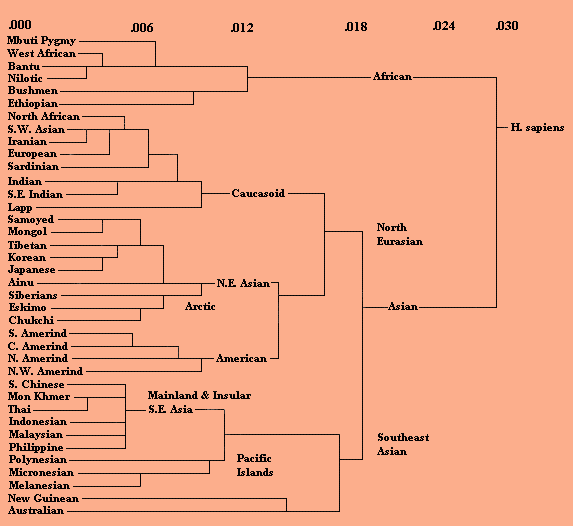
The data in the cladogram shown below are largely or entirely drawn from one article in Scientific American, "Genes, peoples and languages," by Luigi Luca Cavalli-Sforza (November, 1991). This reported the results of genetic mapping of human DNA affinities, the newest theories about larger families of human languages, and a comparison between the two. This cladogram came from the website: Genetic Distance and Language Affinities where you will find several alternative representations of the links between genes and languages.