Feedback Compilation
Feedback for May 2003
Selected reader letters and TalkOrigins responses from May 2003.
Feedback Letter
Feedback Letter
Feedback Letter
Instead of perusing countless articles dozens of pages in length for answers, I thought I'd drop you a line. My curiosity revolves around just how new characteristics in organisms could evolve (even over millions/billions of years) from infintesimally small genetic mutations. Most specifically, how is it possible that complex organ systems such as the eye could evolve from random, blind, genetic mutations? As I understand it, the eye is incredibly complex: it has devices for focusing, letting in certain amounts of light, it has a protective cornea, a system for keeping it clean of foreign objects (eyelids and tears), it works seamlessly with the visual cortex of the brain, and there are neural pathways to and from the eye to communicate realtime data to the brain. How is a system of this grandeous complexity capable of existing through purely mechanistic, random processes?
Do not dismiss me as another cliche bible-banging dogmatist; no, I'm really looking for the answers -- whatever they may be. I'm quite curious as to your answer. Please be as specific as possible.
Regards,
Austin
Response
Since this subject comes up often, I copied a prior response in the February 2003 Feedback.
You can find a number of items on the subect by using the TalkOrigins search feature and typing in "Eyes." This FAQ on Color Vision has some discussion about it.
Charles Darwin suggested numerous small steps that could lead from simple light-detection spots to complex eyes. I have placed Darwin's text from both his 1st and 6th editions of Origin of Species side by side on The Evolution of Eyes: Gradual Change from Simple Forms. Following that text, you will find many links to information confirming Darwin's hypothesis. Scientists are now unravelling genetic pathways in the vision of numerous organisms and finding many interesting features such as the widely shared Pax-6 control gene. It is becoming very evident that the same inherited vision genes can be expressed, in combination with other genes, very differently in different lineages.
Feedback Letter
My point is if we do not explore the biological and chemical "how and why" of living things through genuine scientific enquiry, we may as well write our epitaph thus - "Failed to understand so we therefore perished."
I'll bet most people don't even think about the fact that animals and humans have livers and spleens, lungs and hearts, veins and arteries, etc. Understanding the process of how these vital organs evolve and work for all living things is the key to our survival.
Responses
Feedback Letter
Response
Better photos can be found by typing in "dinosaur trackways" at www.google.com.
Feedback Letter
Thanks,
M. Stradley
Response
Somewhat more, including at least one intelligent review, can be found by typing in "Dr. Periannan Senapathy Ph.D." at www.google.com
His book, along with some reviews, may be found at Amazon.com
Feedback Letter
Response
Feedback Letter
You say in your March 2003 feedback page "Our current best estimate for the age of the universe is about 13,500,000,000 years." Thanks to results from WMAP the same month, we know that it's 13.7 billion years old (to within 1% accuracy). See The Age of the Universe with New Accuracy for the beautiful images and other amazing results.
Response
Age of the Universe
The "best fit" age reported by the Wilkinson Microwave Anisotropy Probe was 13.7±0.2 billion years. Look on the WMAP technical papers page for "Maps and Basic Results" and "Determination of Cosmological Parameters". Those papers, especially the latter, give more of the details about how that number was arrived at. The 13.7±0.2 billion year age is based on a combination of data from WMAP, 2dFGRS and Lyman-alpha forest data, with a "running index model". If the WMAP data alone are used, the derived age is 13.4±0.3 billion years, not all that different. This says that the age is not strongly model dependent, and that several data sets are consistent with each other on the age of the universe. It is a robust result.
But even more impressive is the fact that all of the cosmological age indicators give very similar results. The WMAP age was announced in February, but as of now is still unpublished, except in the pre-prints (though most have been submitted to the Astrophysical Journal for publication). In January, just before the WMAP age was announced, Krauss & Chaboyer, independently studying the oldest globular cluster stars, derived a best fit age for the universe of 13.4 billion years (given without uncertainty, but ±10% is good). This independent affirmation makes the WMAP result look even better ( Age Estimates of Globular Clusters in the Milky Way: Constraints on Cosmology, Lawrence Krauss & Brian Chaboyer, Science 299(5603): 65-69, January 3, 2003).
And note that while the WMAP age is robust, it is not all that different from the age of the universe, based on pre-WMAP CMB data, 14.0±0.5 billion years (The age of the universe and the cosmological constant determined from cosmic microwave background anisotropy measurements, L. Knox, N. Christensen & C. Skordis, Astrophysical Journal 563(2): L95-L98, Part 2, December 20, 2001).
At about the same time, another group combined the CMB data with a study of elliptical galaxies, high redshift type Ia supernovae, and a Hubble constant of 72±8 km/sec/Mpc (the value reported by the HST Key Project), to derive an age for the universe of 13.2 +1.2 -0.8 billion years, remarkably similar to the WMAP age announced about a year later (Setting new constraints on the age of the Universe, I. Ferreras, A. Melchiorri & J. Silk, Monthly Notices of the Royal Astronomical Society 327(4): L47-L51, November 11, 2001).
And, a bit over a year before that, Wendy Freedman, who led the effort of the Hubble Key Project to measure the Hubble constant to ±10%, reported an age based on that work of 14±2 billion years (The Hubble constant and the expansion age of the Universe, W.L. Freedman, Physics Reports 333(1-6): 13-31, August 2000).
Now, I would stop short of saying that we know the WMAP age is the age of the universe. But we can certainly be sure that if it isn't exactly the age, it's really close to the age. All of the evidence, from all of the relevant branches of astrophysics & cosmology, agree with each other, on an age for the universe most likely between 13 and 14 billion years old.
Feedback Letter
Response
Darwin proposed not only that what is now called macroevolution happens, he proposed that all life has descended from one or a few original forms. Surely you will agreed that, if Darwin (and modern science) is correct about this, it must include macroevolution as part of the process.
Furthermore, the title of Darwin's book was "On the Origin of Species by Means of Natural Selection". His purpose was to counter the then prevailing attitude that species were fixed or immutable. He demonstrated some of the ways in which species were mutable (changable into new and different species). His favorite term for this was "descent with modification."
The fact that new species "come to be...well-defined objects" does not imply that there is no transitional period during which modifications occur.
Brief, selective quoting, and taking such quotes out of the context in which they were written, is not the way to learn about any subject, including Darwin's views on evolution.
Feedback Letter
Is it possible that punctuated equilibrium can be explained not just by lots of little changes (the comment that macroevolution is lots of microevolution), but by a building up of potential change behind the scenes.
In other words, either:
1. There are lots of small changes not in the outcomes themselves (e.g. a particular trait), but instead in the underlying probabilities of those outcomes occurring. At some point a threshold is reached, where the change in probability from one generation to the next becomes much more rapid and it takes only a few generations to shift the population.
2. The genes are kind of like a big rusty see-saw. Modest changes pile up on one side of the see-saw, but it's not until they accumulate to a certain level that they actually result in a shift, and the see-saw drops to the other side.
Response
I see no difference between "lots of little changes" and the building up of potential. Accumulating changes in the genotype might take a while before visible changes are observed in the phenotype. The real question is whether or not one might then expect to see really gross changes in the organism.
Personally, I doubt that such a "hopeful monster" process, with real "jumps" or big changes that occur suddenly, happens. Even cases of polyploidy, which involve doubling of genomes and instant speciation, result in physical changes that are very moderate. But, the last word about this is not yet in.
Feedback Letter
Response
The Bible, of course, can and does support many viewpoints. But evolutionary science is grounded in facts, not in beliefs. The belief that prehistoric man coincided in time with dinosaurs has no basis in fact. More than 60 million years separate the two groups of animals.
Feedback Letter
That leaves 3 variables. One variable is constanly changing(rate),the amount of uranium to begin with is totally subjective and the years is the result of am impossible equation
Response
Isotopic dating methods generally involve assessment of the remaining parent and the accumulated daughter product. Both are quantities that can be measured in the present. The original quantity of parent isn't usually involved in the calculation, though it could be computed from the values that are used.
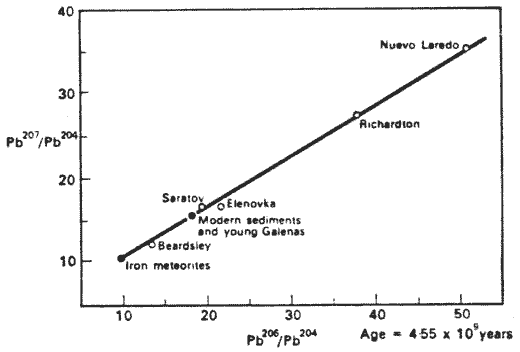
Finally... contrary to your assertion, in most dating assessments there are a large number of equations and measurements, and a comparatively small number of variables. Rather than being impossible to solve (more variables than equations), there are instead multiple independent ways to apply the equations to compute the desired variables. These are more-or-less used as cross-checks on the computed result. For example, consider this Pb/Pb isochron that yields the Solar System's age (and therefore Earth's age):
The simple decay equation for U235-to-Pb207 and U238-to-Pb206 would be:
- Pb207radiogenic = U235 * (eλt-1)
- Pb206radiogenic = U238 * (eλ't-1)
The Pb measured today includes both initial and radiogenic Pb. We can replace "Pbradiogenic" with the equivalent "Pbtotal - Pbinitial" and yield the equivalent equations:
- Pb207total - Pb207initial = U235 * (eλt-1)
- Pb206total - Pb206initial = U238 * (eλ't-1)
Since iron meteorites contain negligible uranium, there is no measurable accumulation of radiogenic Pb in them. The Pb isotope ratios of iron meteorites do not change over time, and thus the Pb ratios measured today in iron meteorites are the Pb ratios present at their time of formation. By normalizing to Pb204, which is not radiogenic, Pb207initial and Pb206initial can be calculated for meteorites which do contain uranium. This changes the simple decay equations to a slightly more complex form -- with the same terms as above, but involving an isotope ratio instead of a quantity in each term:
- [Pb207/Pb204]x - [Pb207/Pb204]i = [U235/Pb204]x * (eλt-1)
- [Pb206/Pb204]x - [Pb206/Pb204]i = [U238/Pb204]x * (eλ't-1)
There are a dozen decay equations of that form which are more-or-less represented in the one isochron diagram shown above (one for the X-value and one for the Y-value of each data point aside from iron meteorites):
- [Pb207/Pb204]b - [Pb207/Pb204]i = [U235/Pb204]b * (eλt-1)
- [Pb206/Pb204]b - [Pb206/Pb204]i = [U238/Pb204]b * (eλ't-1)
- [Pb207/Pb204]s - [Pb207/Pb204]i = [U235/Pb204]s * (eλt-1)
- [Pb206/Pb204]s - [Pb206/Pb204]i = [U238/Pb204]s * (eλ't-1)
- [Pb207/Pb204]r - [Pb207/Pb204]i = [U235/Pb204]r * (eλt-1)
- [Pb206/Pb204]r - [Pb206/Pb204]i = [U238/Pb204]r * (eλ't-1)
- [Pb207/Pb204]n - [Pb207/Pb204]i = [U235/Pb204]n * (eλt-1)
- [Pb206/Pb204]n - [Pb206/Pb204]i = [U238/Pb204]n * (eλ't-1)
- [Pb207/Pb204]e - [Pb207/Pb204]i = [U235/Pb204]e * (eλt-1)
- [Pb206/Pb204]e - [Pb206/Pb204]i = [U238/Pb204]e * (eλ't-1)
- [Pb207/Pb204]g - [Pb207/Pb204]i = [U235/Pb204]g * (eλt-1)
- [Pb206/Pb204]g - [Pb206/Pb204]i = [U238/Pb204]g * (eλ't-1)
Thus, we have a dozen equations, and only one unknown (t). Every other value in each equation is an empirical assessment of a present-day quantity. Every one of the twelve equations can be solved for t, and only if all of the values of t agree will the result be considered valid.
The use of many independent calculations either proves or disproves the requirement that all meteorites started with the same Pb isotope ratios, i.e., it either validates or invalidates the iron-meteorite-based computation for subtracting Pbinitial. If meteorites didn't start out with the same Pb ratios, there would be no reason for all of the various calculations of t to yield the same result. (Further, someone proposing that meteorites started with a range of Pb isotope ratios would have to explain why all iron meteorites have the same ratios.)
Note: This is a somewhat simplified discussion of the isochron data. The U235/U238 ratios are the same throughout the Solar System. As a result of that fixed ratio, uranium assessment can be canceled out of the pair of decay equations for each data point -- the two equations and the fixed uranium isotopic ratio can be solved into a single more complicated equation that does not involve any assessment of uranium. That is a closer approximation to the calculation underlying the Pb/Pb isochron age.
See our Isochron Dating FAQ for more detail on isochron dating techniques.

Feedback Letter
1.) Animals reproduce.
or
2.) Animals die.
Seems pretty obvious that if evolution didn't happen, something VERY strange would have to be happening in these 2 processes. Anyhow, that's how i look at it. Thanks for the site.. love it. Great to read.
Response
1.) Animals reproduce with variation.
2.) Some of the variation is inheritable.
3.) Animals die, and some of the variation makes some of the animals more likely to die than others.
(And of course, this applies to plants, fungi, bacteria, protists, and artificial life too.)
Given those conditions, all of which are easily seen, evolution is inevitable. Creationists assert that there are barriers that prevent one "kind" from changing into another, but they have yet to give the slightest bit of indication of such a barrier.
Feedback Letter
Response
Six minutes after posting this query you posted another one. Perhaps you could have read a FAQ in that period of time.
If I write a really thoughful summation for you, I might spend 15-30 minutes or more at the task.
When is your homework assignment due?
Feedback Letter
Where?
Response
Tas Walker's response for AIG does not convincingly address the second and third points. He says, essentially, maybe some of the original carbon remained. Okay, but more likely not. And he says there was enough carbon to do the analysis, but that could come from contamination. He repeats that they ruled out contamination, but they only ruled out contamination from microbe and fungi, not groundwater. Walker says the wood was above the water table, but groundwater would still percolate down from the surface.
Finally, Walker mentions other discordant dates, such as young C14 dates for ancient coal. The Carbon-14 in Coal Deposits page addresses this claim, and its conclusion (that carbon dating can sometimes be thrown off by C14 created in situ by radioactivity in the surrounding rock) could apply also to the fossil wood found in Triassic sandstone.
Feedback Letter
Mr Behe's work theorized that for irreduciblly complex biological features, DIRECT Darwinian pathways are procluded, i.e. improvements to a given function.
In the responses I've seen, from Miller and others, this idea comes under attack. However, I keep seeing only indirect pathways proposed as a response, i.e. biological units whose function is proposed to have changed over time before being incorporated into an irreducibly complex biological unit.
Questions therefore come to mind: 1. Is Behe's point that for irreducibly complex biological units, DIRECT Darinian pathways are procluded conceded? 2. If not, present some experimental examples of Direct Darwinian pathways for proposed irreducibly complex biological units. 3. Are the indirect pathways proposed for irreducibly complex systems (a la Miller with the bacterial flatula) presented as contradictory to Behe, even though his theory does not address them, because his book and its proponents give the impression that his theory DESTROYS evolution? Are they aiming to correct this false impression? 4. Are they proposed, because their proponents do not understand the difference between direct Darwinian pathways and indirect ones? 5. Are they simply proposed as an escape hatch for Darwinian evolution to avoid Mr. Behe's blow?
Regards
Response
1) Maybe. The problem is that Behe picks systems for which we currently have limited knowledge, so it's hard to say.
2) You tell us precisely what you mean by "direct Darwinian pathways" first.
3) I really, really like your "flatula" malapropism.
The indirect pathways do contradict Behe's implication that IC refutes evolution. IC doesn't.
4) They are proposed because they demolish the basis of Behe's argument. I don't understand why you are bringing up this stuff about direct vs. indirect evolution -- it isn't relevant. There has never been any requirement that evolution proceed by some kind of specific, linear, simple pathway.
5) Dr. Behe has not delivered any kind of blow to evolution. He has rather blown his own reputation, but nothing more.
Feedback Letter
Response
In order to infer how "human" reproduction might have evolved it is necessary that we look at the reproductive systems of our closest evolutionary relatives among the primates and determine by how much we differ from them (not very much). Looking backward in time to our common ancestry with more distinct mammals we can chart a few more differences (say, litter size, gestation periods). Further back in evolutionary time we find differences in egg type and production and methods of fertilization.
Unfortunately, reproductive systems and behaviors do not fossilize. We have no other choice but to look at living organisms and branching points and patterns that refer us back to common ancestries. This is also true for other complex systems or organs such as eyes, digestive systems, etc.
Because of the amount of inference required in piecing together plausible answers to such questions, biology textbooks often concentrate on how current biological systems work and not on how they may have evolved. There are available highly technical books with hypotheses about the evolution of sex and the fascinating diversity of reproductive strategies.
We simply do not have all the answers to some questions. The origin of sex and reproductive systems remain high on the list of incompletely answered questions in biology.
Feedback Letter
Thank you for your help!
Response
Creationist commonly assume that quantized redshifts are a proven fact, and always base their arguments on this false assumption. But, unsatisfied with only one false assumption, they proceed to accept an even worse false assumption, namely that quantized redshifts and Big Bang cosmology are incompatible. This is most certainly false.
Big Bang cosmology is built around the central principle that the early universe was very small, very dense & very hot. But there are a lot of ways to construct detailed models of space-time which adhere to this fundamental principle, and yet produce radically different observable universes. In the case of quantized redshifts, they are easily accomodated within a Big Bang cosmology simply by quantizing time, a procedure advocated by Tifft himself (i.e., Three Dimensional Quantized Time in Cosmology, W.G. Tifft, Astrophysics and Space Science 244(1-2): 187-210 (1996)). You would think that the scholarly creationists would have noticed this paper by Tifft, which refutes the notion that quantized redshift & Big Bang cosmology are incompatible. But, curiously, they seem never to mention it.
Quantization in redshifts, even if real (which is at least debatable), does not affect the redshift-distance relationship, and presents no major problem for Big Bang cosmology, or a 13-14-15 billion year old universe.
Feedback Letter
Response
He's a businessman also, not trying to cash in on tax-exempt status as do some of his buddies, who include Carl Baugh.
In any event, I cannot find any rebuttals by scientists about anything Taylor has placed in print. I suspect the reason for this is that he does not seek the notoriety that drives people like Baugh and Hovind.
Feedback Letter
I investigated creationist's arguments against dino-bird theory and I found that Creationists changed their tactics of argumentation. Now they try to attack the theory, but they try to ignore morphology of transitional fossils, or they say mad things. For example, "Confuciusornis has the same skeletal structure as modern birds…" Archaeopteryx and Other Ancient Bird Fossils. ;-) Now Creationists say that birds did not evolve from dinosaurs, and "there are no transitional forms". Creationists say about bird's lung structure and phalangeal formula. But there are no responses to this Creationist's arguments from evolutionists. I think that evolutionists must write the response. I don't want to say that Talk.originists must do it, but someone must. Creationists say many falsehoods about the fossils; they use old and doubtful data. Furthermore, they ignore many evidences. I found that Talk.origin's FAQ about feathers (www.talkorigins.org\faqs\feathers.html) is weak. But there is a great FAQ - "THE EVOLUTIONARY ORIGIN AND DIVERSIFICATION OF FEATHERS"; by RICHARD O. PRUM and ALAN H. BRUSH. The Quarterly Review of Biology, September 2002, Vol. 77, No. 3.
A few links.
- Kentucky Fried Dinosaur?
- Bird Evolution flies out the window
- Dino-Bird Evolution Falls Flat!
- What? Another feathered dinosaur claim?
- New four-winged feathered dinosaur?
- On the Alleged Dinosaurian Ancestry of Birds
- Archaeopteryx, Archaeoraptor, and the "Dinosaurs-to-Birds" Theory [Part II]
- Scientific American admits creationists hit a sore spot
- Ostrich eggs break dino-to-bird theory
- Yet another new 'feathered' dinosaur?
- Be Skeptical About the Skeptics!
Creationists use quotations from works of Feduccia. Feduccia about creationist's quotations:
"Creationists are going to distort whatever arguments come up, and they've put me in company with luminaries like Stephen Jay Gould, so it doesn't bother me a bit. Archaeopteryx is half reptile and half bird any way you cut the deck, and so it is a Rosetta stone for evolution, whether it is related to dinosaurs or not. These creationists are confusing an argument about minor details of evolution with the indisputable fact of evolution: Animals and plants have been changing. The corn in Mexico, originally the size of the head of a wheat plant, has no resemblance to modern-day corn. If that's not evolution in action, I do not know what is."
Ornithologist and Evolutionary Biologist Alan Feduccia Plucking Apart the Dino-Birds
And a small joke. Creationists: The theropod dinosaur hand consists of the thumb and the next two fingers. The bird hand is made up of the middle three fingers. How could it evolve? Well, creationists say that Caudipteryx and Protarchaeopteryx are more likely to be flightless birds. But Caudipteryx and Protarchaeopteryx had heropod phalangeal formula of 2-3-4-x-x (nature 393: 753-761). How could it evolve?
Sorry for my English.
Response
Feedback Letter
She summarized the current results of chimp genome research. There are two decoding projects on chimps going on. Ms. Pearson's comments concern one project in Japan.
Researchers decoded chromosone 22 on the chimp genome. This chromosone is analagous to chromosone 21 on the human genome. Surprisingly, instead of the expected difference of 1.35%, the genetic difference was 5.5%, about four times as much.
This project had achieved the greatest decoding and comparative analysis of the chimp genome and its human analog. Previous comparisons where based on much smaller genetic segments.
If the initial results of this project are confirmed then:
1. Genetic differences between chimps and humans are four times as large as previously estimated. Based on those previous estimates, the chimp line was estimated to have split off from the human line 5 to 7 million years ago, while modern humans where estimated to have decended from the last common ancestor between 120 and 250 thousand years ago. 2. If genetic differences are actually four times larger than this, the ability to move the split with chimpanzees back in time is rather limited by other evolutionary splits and the fossil record. An 8 to 10 million year upper limit seems reasonable for the split between our ancestors and those of chimps. 3. However, this in turn takes the age of "Eve" down to about 75 thousand years, at the upper limit and to 50 thousand years if the current 6 million year age for the chimp-human split is maintained. 4. Wouldn't this 50K to 75K range contradict claimed ages for some South African and Palestinian fossils? 5. On the flip side, wouldn't a 50K to 75K for anatomically modern humans be more consistent with the "explosion" of humanlike activity apparent in the fossil record beginning about 40K years ago than the current 120K to 250K? 6. Is it a problem that a 50K to 75K range for mithcondondrial "Eve" is very close to the Old Earth Creationist age of 40K to 60K? or would it not matter because the former would be derived from hard science and the latter is derived from bad theology?
Response
"The data call for some revision of the estimated genetic similarity between us and our closest relatives. Previously, human and chimp genetic sequences were quoted as being nearly 99% identical, with a difference of only a few DNA's letters. In fact, the similarity may be as low as 94-95%, says Todd Taylor of the RIKEN Genomic Sciences Center in Yokohama, Japan.
"Taylor's team factors in whole segments that they found to have been added to or subtracted from one of the genomes; previous estimates were often produced by comparing smaller areas. "There's still not a good way to say how much we're similar," admits Taylor." [end quote]
This is a case of comparing apples with oranges. Different parts of genomes exhibit different rates of mutation (change). Genes that are actually expressed tend to be more highly conserved and change less often than that part of the genome commonly called "junk DNA."
See my response to Ibn Ifendi on the same topic in the March 2003 Feedback. Part of that response states:
"Carl Zimmer addresses this issue as well as the controversy over including Indel and junk DNA in such calculations. See his essay Searching for Your Inner Chimp which appeared in Natural History for December 2002 - January 2003."
Feedback Letter
Response
Personally, I think the theory of Punctuated Equilibria has been well documented in the years since it was put forward by Niles Eldredge and Steve Gould. However, it is not some kind of either/or theory. For instance, it does not replace natural selection, although some writers suggest that this was the intent of Eldredge and Gould.
The real question is, how important is punk eek in the entire structure of evolutionary theory? Scientists DO argue over the weight or relative importance of any subtheory or hypothesis when considering the whole subject.
Very few evolutionary biologists would totally discard any well-tested theory. You can be sure that over the years, as scientists discover more about the details and mechanisms of evolution, that some of these "mainstream" subtheories or hypotheses will be modified to accomodate the new findings.
There are also a number of hypotheses that either have been recently proposed or that have not yet undergone rigorous examination. Some of these may fall by the wayside as more work is done to test them.
Feedback Letter
Response
Our species, going backward from our most recent ancestors to most distant, has evolved through the primates --> mammals ancestral to primates --> reptiles --> amphibians --> fish --> and back to single-celled forms such as bacteria.
WE did not mate with THEM. Millions of years ago we had an ancestral species that was fully reptile, but whose offspring started the process of divergence or splitting away from the ancestral stock. They were still reptiles who, over time, gradually became less reptile-like and more mammal-like. These proto-mammals eventually crossed the threshhold to full mammal status. Mammals then lived beside the dinosaurs (fully reptile) and other reptiles for many millions of years. The dinos eventually died out, but one of their branches survived, and we now call them birds. By convention we do not call birds reptiles, but they really can be thought of as living dinos.
Birds and mammals both descended from reptile ancestors, but not from the same group of reptiles.
During embryology we appear to share many features with a wide assortment of other animals. Some of these features disappear during embryonic development, some of them go through a process of conversion to distinctly different organs or structures. The reasons for the similarities are basically due to our sharing an "original" vertebrate body plan which, over time, has diversified. The loss of most of the tail is just one of our diversifications (shared with our closest living relatives).
Many of these details will become clearer as you continue your reading. Have fun. It's a great journey.
Feedback Letter
Response
In any case, information theory does not preclude evolutionary change occurring, because natural selection acts like a kind of Shannon's Demon, adding informational relevance to the effects of noise.
Feedback Letter
The one thing that I never hear mentioned by the so-called "creationists" is how the Holy Spirit has infultrated their life and gave them a love for God and His Word. They forget or don't understand, I think, that this is supernatural and they hit the ground running instead of reading. There is a spiritual maturity that comes through obedience to God's word--and that takes time. What society so often sees when they look at American Christianity is false, or immature believers trying to do "right". You see them in these debates and in politics where they think they can bring God's blessings to men through the political lobbying of Judeo-Christian concepts into society. Millions and millions of dollars are thrown into these campaigns instead of helping the hurting, and we will be judged for it.
See, we as believers, "know" there is a God because we have experienced Him and we often get caught up in worldly causes trying to get others to do the same.
Yes, there is science as a result of the creation but it was no more expected to be a Christian concern than explaining the deity of Christ--but we do.
Sincerely, Job
Feedback Letter
Response
Anthropologists also use a number of dating methodologies other than radiometrics. You might wish to visit some of the links, grouped under 20 Dating Methods on my website.
Basically, radiometric dating examines the isotopes of elements found in rocks. A radioactive isotope breaks down or decays over time (perhaps through several decay steps) to a stable "daughter" isotope. Unless the decay process has fully run its course, a sample will contain some percentage of parent isotope and some percentage of daughter isotope.
For instance, in a simple situation, if the half-life of an isotope is 1 million years and your sample is 50% parent and 50% daughter, that sample is 1 million years old. If the ratio is 25% parent : 75% daughter it is two million years old.
A simple chart, for each decay rate, can be consulted to determine the age of a sample, based on the isotope ratio determined by testing. You will find in the links provided above a list of many isotopes and the half-life or decay rate for each.
There are many labs around the world to which samples may be submitted for testing. Often, multiple samples from a site under investigation are tested in two or more labs to guard against possible testing error.
Feedback Letter
Response
Darwin's authority in this matter is irrelevant; people don't accept the fact of evolution because ol' Chuck said so, but because the evidence is in its favor.
Furthermore, he did not claim that we were created by a supreme being, but rather argued to the contrary. I don't know where you got this false idea. Is it because of the phony Lady Hope story, or because you've overinterpreted his one poetic mention of a creator in the Origin, which he is also on record as regretting?
Feedback Letter
Ther say drug addiction is bad but i have the shakes cause i need my feedback fix
MORE FEEDBACK MORE FEEDBACK MORE FEEDBACK MOREFEEDBACKMOREFEEDBACKMOREFEEDBACK
i need my dose of creationist idiocy being debunked.....i need someone saying how stupid the archives are for thinking the earth is flat.......I NEED SOMEONE SAYING HOW SMART HOVIND IS AND HOW HIS ARGUMENTS WILL PUT ALL HIS DOUBTERS TO SHAME!!!!!!!
Response
I apologize for the delay in getting the March feedback online. I was in Texas defending my dissertation and giving a presentation at a conference in San Antonio.
Wesley
Feedback Letter
Response
"No one who has not read the Bible or the Bard can be considered educated in Western traditions; similarly, no one ignorant of evolution can understand science." ~~ Steve Gould in I have Landed, p. 215 (Darwin and the Munchkins of Kansas). Also in Time magazine, Aug. 23, 1999.
Feedback Letter
P.S U SUCK
Response
It's worth noting that this person made SEVENTEEN posts in a similar vein, all within a few minutes of each other.
It's really rather pathetic.
Feedback Letter
1. Do you accept that your side believes in certain assumptions that cannot be proven?
I don't really want to dive into the flood of analyzing scientific data, but I am curious to your response on this point - I was reading through your evidences for evolution. To my mind all I see are similarities in design. It is a fair enough theory to suggest they evolved, but if they were created all your research fits well into a creationist theory too.
2. Have you seen this perspective? Do you agree or disagree? Why?
Essentially science seems to be able to advance quite well regardless of whether you believe in creation or evolution. Again I can get myself into a neverending debate, but I'm willing to say the most significant scientific advancements were all from dedicated Christians who were creationists (or at least belief in a God - Newton, Einstien, Kelvin, Pasteur, Mendel etc..) (although you can be a Christian and an evolutionist too)You may disagree, but I would like to hear more on questions 1 and 2. (I know we can go a lot deeper on this so I'm happy for you just to disagree on that)
Regards,
Andrew.
(science teacher, medical scientist, bible college student)
Response
I think you are asking if science (rather than some side) deals in assumptions. The only assumption in science that comes to mind is that there is an observable reality in nature and the universe -- that what we see is real, not some fiction of our mind. For instance, an atom of oxygen is real, and has certain properties that are stable - in the past, present and future.
As for "proof," that concept is best left for math and, perhaps, theology. Science deals in probabilities. I don't think we should consider (in biology or natural history) things to be "proven" or "true" in the sense of having arrived at some ultimate answer or conclusion that is never subject to change or correction. I do not know how we could ever be certain that there is not something more to be learned about anything.
2. Regarding design, I admit the possibility of thinking that one can see design in nature. But I can find no reason to presume that such possible design was imposed by a Creator rather than being the outcome of a natural process establish by or without a Creator. In fact, if we accept that a Creator is the logical reason for perceived design, I think we are obligated to ask ourselves some questions about this Creator or designer.
When I see in nature evidence of bad design (something that could obviously be more efficient in operation) am I to conclude that the designer botched the job or was in some way incompetent? In real life we look for good design in competing products and we expect warranties against defect and premature breakdown. In other words, we rightly hold designers and creators to certain standards. May we do this also with regard to natural productions?
Another problem when considering a designer in nature is that of disuse or elimination of parts of the design. I must ask myself why a designer would go to the trouble of creating a certain model of living organism, only to have that organism, over time, throw away much of the creative handiwork. Many parasitic organisms have done just this.
Evolutionary theory provides answers to such questions. I can't seem to find satisfactory answers anywhere else.
I agree that a Christian can be an evolutionist too. Here is another to add to your list, Theodosius Dobzhansky, a great geneticist and evolutionary thinker. Nothing in Biology Makes Sense Except in the Light of Evolution
Feedback Letter
Response
Don't confuse intellectual ability with cultural advancements. When our ancestors dispersed from Africa they were perfectly capable of adapting to different climates and making a living. We are certainly no smarter than those who invented agriculture, animal husbandry, metalurgy, art and storytelling.
The quickened pace of discoveries had to await a few other inventions. The establishment of writing, libraries, the printing press, scholarly disciplines, advanced institutions of learning, science laboratories, the computer you use and other communication devices -- these allow us to move forward as never before.
Most of these have come about in just the last 500 years or perhaps 20 human generations. They are not the products of biological evolution, but of human culture.
Feedback Letter
Feedback Letter
I have been teaching in public education now for 11 years. I love kids and I love science and history. I have a passion for the truth and I have found very little of it on your web-site. I am looking for a website where my students can get an un-biased look at origin science. I want my students to know the evidence for and against evolution so that they can decide for themselves. Your website is very deceiving because "Talk Origins" implies that you have an openminded approach to origin science. I take a very speculative approach to origin science in my classroom and the majority of my students are convinced that Intelligent Design is much more believable after evidence is brought forth from both sides. Censorship has no place in education and I am convinced that "Talk Evolution" I mean "Talk Origins" is stuck in a very naturalistic dogma that hinders the mind.
Educator, Brady Mayo
Responses
My perception (admittedly based only on the testimony above) leads my open mind to understand that Brady Mayo confuses his anti-science bias, opposition to legitimate scientific method, and his personal pseudoscience agenda with a sound lesson plan to guide the instruction of students.
A science classroom in which "anything goes" or passes for acceptable evidence is in itself a form of censorship. What is being censored is critical thought.
Feedback Letter
Chris Ho-Stuart wrote in March 2003 Post of the Month
In America in particular (not so much in the rest of the world, thankfully) there is a strong view being pushed that showing how natural processes are the cause of some phenomenon is the same as showing that God is not involved. There are basically two kinds of people who push this idea of a conflict between science and religion; on the one hand strictly materialistic atheists; on the other hand so-called scientific creationists.
I couldn't agree more. Atheism and creationism are essentially two sides of the same coin. They both use the God-of-the-Gaps -argument, or -fallacy, but in opposite directions. Atheists conclude that there is no God because scientific knowledge does not have enough gaps (any more) for God to exist. Creationists assert that numerous and insurmountable gaps must exist because God exists.
The common ground of the two is the western over-rational attitude towards theological and spiritual issues. I think the Protestant reformation is to some extent responsible for that.
About definitions: The word 'Creationism' should mean only "scientific" creationism; that is, a movement that tries to promote biblical literalism by empirical evidence (e.g. Flood burial of fossils) and by scholastic imagination in cases when the scarce information the Scripture actually has is not enough (e.g. the *true* meaning of the word "Kind" in Genesis, and imaginative calculations about how Noah's Ark was a feasible nautical project after all...). It should NOT mean that someone merely believes in God, Creation, the inerrancy of the Bible, etc., which is usually referred as 'biblical creationism'. If creationist views do not have any empirical or logical basis outside the Bible, then they cannot be an alternative to evolutionary science which has that basis very splendidly.
It would be interesting to know how many of those who are categorized as 'creationists' in various "what do you believe in" -polls are really empirical creationists, and how many are just creation-believers who don't know or care about any non-biblical evidence dealing with God's work.
In Finland many common religious people may say, when evolution is mentioned, that they believe in what the Bible says, and that's that. They don't try to change science; they ignore it. I have found very little point to argue with them, and usually they don't care about the topic either. The real creationists, most of which are members of some minor religious groups of American origin, are a completely different case...
To me it really is an utter fallacy to assume that God is not involved in something that can be explained by natural processes. I think every Christian must believe that God acts continuously and in infinitely many ways in everyday world. God is Almighty, or not a God at all. Diseases and wheather have been explained by the same "naturalistic" science that the anti-evolutionists so fiercely curse. So, obviously God has retired from governing diseases and wheather, or has He? Could any Christian accept that thought? If not, there's no logic to assert that life's origin must not be natural in order to be God's work. A part-time-God that only makes divine miraculous interventions (apparently not very often) but nothing else is not the Lord I want to believe in.
Response
You may be interested to know that I am an atheist. However, I don't consider this to be a matter of scientific proof, and I think the approach you describe does allow for a rational combination of theism with the empirical discoveries we all can make by application of scientific methods.
Feedback Letter
Response
My edition of the NIV says at Prov. 26:7 ~~ "Like a lame man's legs that hangs limp is a proverb in the mouth of a fool."
The Jewish Publication Society Tanach renders this verse as ~~ "As the legs hang limp on a cripple, So is a proverb in the mouth of dullards."
But let's consider also Prov. 26:16 ~~ "The sluggard is wiser in his own eyes than seven men who answer discreetly." (NIV)
The JPS Tanakh renders this as ~~ "The lazy many thinks himself wiser than seven men who give good advice."
Proverbs is one of many examples where, in the Bible, one cannot take things literally. Metaphors, parables and allegories always require thoughtful translation by the mind and rarely yield the same result to different individuals.
I doubt seriously that you "take the bible literally."
Feedback Letter
• "Evolution and the Bible are not compatible." • "Evolution breeds monsters like Hitler, Trotsky, and Stalin. Quick-read this article: Darwin's 'survival of the fittest' ideas." • "Evolution can not be proven is because it takes too long." • "Evolution can rationally be classified as one of the worst superstitions of all time." • "Evolution can't advance." • "Evolution CAN'T BE THEISTIC: design always points to a Designer." • "Evolution can't be true. This is a guide to help counteract the lies spread by evolutionists." • "Evolution can't happen: There Ought to Be a Law Against Evolution!" • "Evolution Can't Take the Heat." • "Evolution cannot be true. Something cannot come out of nothing." • "Evolution cannot take place in an open system such as the earth." • "Evolution Doesn't Add Up! BIBLICAL PERSPECTIVE: “In the beginning, God created." • "Evolution doesn't work." • "Evolution is a scientific hoax." • "Evolution is bogus!." • "Evolution is Dangerous Nonsense." • "Evolution is defective." • "Evolution is disappointing." • "Evolution is Impossible. All life contains DNA, so for evolution to be true the DNA molecule must first evolve." • "Evolution is irrational on pure mathematical grounds. Stay tuned for Why Evolution Is Stupid." • "Evolution is not the answer to man's origins." • "Evolution is not the best scientific answer." • "Evolution is theologically impossible." • "Evolution is theory and NOT fact as SOME would TRY to have us believe." • "Evolution is wrong." • "Evolution is wrong or unproven." • "Evolution is wrong. Evolutionary theory is a myth." • "Evolution is wrong. There never was a Big Bang, and stars cannot evolve from gas. Here are scientific facts to prove it." • "Evolution isn't a reasonable explanation for the origin of man." • "Evolution makes no sense. You don't get something from nothing." • "EVOLUTION ONLY IS CONTROVERSIAL AND SHOULD BE REPLACED WITH OBJECTIVITY." • "Evolution Scientists tell why evolution is not supported by the facts!." • "Evolution should not be taught as fact." • "Evolution should properly be viewed as religion." • "Evolution Shouldn't Be Preached in the Schools." • "Evolution simply cannot be true." • "Evolution: The Truth is Not in it!!." • "Evolution violates both these laws of science: the First and Second Laws of Thermodynamics." • "Evolution will not fly."
I’ve been studying the psychological phenomena associated with religious mystification for some time now and have come up with a theory: In the sense I use the word, “mystification” is the mentally-fixated quality or state of being perplexed or bewildered by factual reality that seems to contradict what one deeply believes to be true but at the same time being unable to recognize the associated cognitive dissonance as anything other than “noise.” Denial, then, becomes their only psychological recourse. Religious people, of course, may or may not be mystified. Those religious folk who are not mystified may adjust their beliefs to account for empirical, factual reality. For example, I, who call myself a God-fearing evolutionist, believe that God created evolution to be free (unguided) just as he created human beings to be free. But those who are in denial cannot modulate their rigid belief system at all. Hence, they invent or parrot rationalizations — as quoted above.
What do you think of my theory?
Response
Best wishes,
Bob
Feedback Letter
Question: What is a good response to this seeming oddity? Obviously there is a large difference between us and fruit -- what else accounts for the difference besides just DNA?
Thanks, Bradley
Response
Playing this numbers game, and if the 50% figure is true for bananas, we are more than 1,500 times different from bananas as we are from each other. Should I rest my case?
If I am not mistaken, no banana genome has been decoded yet. While the human genome is now just recently "finished" you cannot yet get a precise count on the number of genes. So, in these early comparisons between distant genomes, we may not be comparing strictly apples with apples.
In any event, it is becoming apparent that gross differences in genes probably cannot account for the gross differences we see in nature. Since genes code for proteins, and all living things are composed of proteins, there just has to be a great deal of overlap in protein use to make anything. I suspect that the differences in control genes guiding development may turn out to be a much more important factor in determining differences or similarities between organisms, than some quick-and-dirty method for gross comparisons of genomes.
If this is true, we will simply have to wait for much more work in genomic analysis to be performed to better answer such questions.
Feedback Letter
I have read an article that explained it (no, I can't find the reference, but if you want it I can have a poke around), but the explanation was flawed, so I am looking for a better one.
Concerning the change from single entity sex to two entity sex, the article had the following explanation (I may be getting my terminology wrong here, feel free to substitute the correct terminology):
Two entity reproduction offers an advantage in that genetic differences can build up in the redundant state, meaning that mutations would not necessarily be lost due to the organism being wiped out for being inefficient. This form of reproduction allows mutations to accumulate until chance brings them out in a single advantageous individual.
However, this explanation begs the question. It does not offer an explanation of how the different reproductive systems emerged, rather it describes them as advantageous (and thus assumes they will occur because they are advantageous).
I am interested in an explanation of the evolution of each change, however if this is too difficult an explanation of one change would suffice.
Response
Another query dealing with the evolution of reproductive systems appears higher up in this file (see "Sometimes we ask the wrong question...."). You might read that to save me from repeating it here. I ended that response by stating "We simply do not have all the answers to some questions. The origin of sex and reproductive systems remain high on the list of incompletely answered questions in biology."
Please remember that reproductive systems entail much more than sex. Complex organs are involved, and those organs can vary, even between very closely related species. Scientists working in the field of evolutionary development are beginning to gain insights into some aspects of reproductive evolution.
Last November a fascinating article appeared in the journal Science regarding the evolution of the placenta in a genus of fishes. With the permission and assistance of Dr. David Reznick I posted this webpage that you may find of interest: Evolution of Placentas in Fish. As I point out, it is still "early days" in this research program.
You have probably read of other fascinating cases in which some fish can, depending upon environmental or social conditions, actually change sex. In other cases (the Jefferson Salamander of the Appalachians comes to mind) a genomic change called polyploidy can result in a "new hybrid species" that produces only females. In this case, males of one of the species contributing to the hybridization are still necessary to stimulate reproduction by the females, but male sperm makes no contribution to the genetic makeup of the offspring.
There are lots of seemingly weird situations in nature regarding sexuality and reproductive systems. In some cases these situations provide scientists with model animals for laboratory studies where it might be possible to engineer or reverse-engineer the genetic changes involved (as in the case of the placentas mentioned above). However, such studies can be very costly and time-consuming, and we will simply have to wait for opportunities for such research programs to be funded and carried out.
It is to be hoped that some of these difficult puzzles with soon be solved.
Feedback Letter
Response
This FAQ depicts the Hypothetical Ur Cell without much discussion. Since it is hypothetical the intent is only to suggest what might have been. The FAQ also presents considerable information about abiogenesis hypotheses.
Another file that may be helpful is Progress in Abiogenesis Research: Post of the Month: January 2002. In some respects that file may be more directly help than a webpage I put together with a collection of links on Abiogenesis -- Origin of Life Research.
If you have time to read the book The Spark of Life you will find a wealth of information about various abiogenesis hypotheses and research programs.
Feedback Letter
A few years later I happened to stumble onto this wealth of information, and spent quite a long time reading the articles, following the links, and educating myself about the subject, with your help. It's too bad that my high school, which made a big deal about calling itself THE school for science and technology in the area, failed to educate its students about a rather important, and quite often severely misunderstood (especially by younger people, it seems), scientific theory. I hear that they have since improved, but that doesn't help those that have already graduated.
Thanks again for a very useful web site. Keep up the good work.
Response
After just a few months answering some of the Feedbacks it is easy to get a bit discouraged by some of the postings. Sometimes we tend to think this is just about confrontation, entrenched viewpoints and religious bias. I have no doubt that many people use the resources of this website to help educate themselves.
When I attended high school (pre Sputnik), Darwin and evolution never came up in the standard biology class. This might be far less true today, but the sidestepping you mention is not uncommon.
Also, some of the science we did learn years ago has been made more accurate by later findings. Learning does not stop at the schoolhouse door.
Feedback Letter
Response
"No one who has not read the Bible or the Bard can be considered educated in Western traditions; similarly, no one ignorant of evolution can understand science." ~~ Steve Gould in I have Landed, p. 215 (Darwin and the Munchkins of Kansas). Also in Time magazine, Aug. 23, 1999.
It might open the door for you to present reasonable evidence with which to counter ignorance. The FAQs on this website provide much evidence to help you prepare for fact-based discussions.
Feedback Letter
Dear Atheologian
The creationists often use my work in support of creation science. They do this by pointing to the fact that I disagree with the notion that Australopithecines were bipedal in the manner of humans. In this, they are correct. My work implies that, though the Australopithecines may well have been bipedal, it was not in the manner of humans, and they they could also operate very well in the trees. This was contrary to what my colleagues were saying years ago. But most of my colleagues have now come round to the view that this is indeed so. This is a functional diagnosis: what form of movement the Australopithecines were capable of - and obviously the form of the skeleton tells one something about function.
When one applies this functional diagnosis to the question of genetic relationship, it implies that the Australopithecines were not intermediate between apes and humans, and also that they were not on the "direct" human lineage. They were nevertheless in the same part of the evolutionary bush as humans, but on twigs that went extinct.
The creationists conveniently don't report this implication of the finding that they are happy to report, in other words, they use selective "quotations".
Hope this helps
Charles Oxnard
Feedback Letter
and the universality of the belief of the age of the universe being >10 billion years is so strong....
How could a thinking person believe in an earth (universe) of 10,000 years only???
Response
New tools and methods of investigation were required to demonstrate that the Earth is 4.56 ± 0.02 billion years old. Recently, new technologies have narrowed the dating of the age of the universe to something close to 13.7 or 14.0 billion years.
Many people have never heard of these factual advances in science, or they prefer to ignore them in favor of one or another traditional belief. Many persons learn some of these facts here for the first time. The Age of the Earth FAQs is a good place to start.
Feedback Letter
Thaks,
Landon
Response
A number of the volunteers here are Christians. Obviously, they accept evolution as factual science without perceiving it as a threat to faith.
In the USA most evolutionists are also believers (with the great majority of them being Christians). Often, they are referred to as theistic evolutionists.
Your comment about "all true Christians" strikes me as reflecting a depauperate view toward ecumenism and the body of Christ. I hope I am wrong about this.
In any event, you might consider these comments:
No one who has not read the Bible or the Bard can be considered educated in Western traditions; similarly, no one ignorant of evolution can understand science. ~~ Steve Gould in I have Landed, p. 215 (Darwin and the Munchkins of Kansas). Also in Time magazine, Aug. 23, 1999.
Feedback Letter
I wish there was a web site which would show his actual calculations. I have never been able to find one even on Creationist web sites. Thanks.
Response
Elsewhere on the web are files detailing the argument over who it was that published the actual hour of creation and what that hour was. It has often been misreported.
The dates for Ussher's life are usually given as 1581-1656.
Feedback Letter
The night I turned 21, like most Americans, I got completely falling-down drunk. And, as a side effect, I was introduced to a lovely little effect, namely the drunken revelation. Mine was earth-shatteringly brilliant, and all around (except the stupid skeptical designated driver) who had the mind to think so agreed. In fact, it seemed to fit the facts of the matter SO much better than the orthodox beliefs. It was truly monumental.
Then again, when your drunken revelation is that the entire history of the band The Cure can be explained if you just assume that Robert Smith and Simon Gallup were in a particularly shaky romantic relationship, you're kind of preaching to a small population.
Needless to say, when I woke up the next morning wearing one boot, hung over to no end, and clutching a detailed flowchart (I wish I was kidding) of how all the albums post Disintegration are little more than stop gap measures in a dying love affair, I felt moderately silly. My friends, now turncoats, were even more venhement on my silliness. I mean, how, even in the flood of alchohol, could one BELIEVE such things?
It's actually quite easy. Combine a lot of knowledge of one set of facts with a small knowledge of another, and carefully turn off any logic which would argue against your new pet theory, and you have a ready-made point for crusade. Creationists have combined knowledge of Genesis with slight knowledge of the past (often no more than what Hovind would teach) and have turned off the part of their brain that goes "That's SILLY!" with...I hesitate to say "faith", but it's the only word that comes to mind.
Unfortunately, I fear that, for them to become sober, one needs to apply much more than a muzzy night's sleep on a friend's couch. In this regard, I thank you for your work. The Talk.Origins Archive functions as something of a cold blast of water. If only more people would stay still long enough to get drenched!
Feedback Letter
Response
Feedback Letter
Thank you.
Response
Hovind makes other statements here that are clearly false. For instance, he says that, with respect to birth defects, "It is only when both parents have the same mistake in their genes that their children manifest the resulting genetic problem." Huntington's Chorea, however, is caused by a single dominant allele, and thus is passed by only one parent.
Hovind, quite simply, doesn't understand what he's talking about.
Feedback Letter
Feedback Letter
"The evolutionary basis of homology is perhaps more severely damaged by the discovery that apparently homologous structures are specified by quite different genes in different species..."
1. To what extent is this true, or is it even true at all? 2. Although my book stated that Denton was an evolutionist, I have trouble believing it. Is that possible? 3. If he is an evolutionist is this just another quote taken out of context?
Thank you for your time.
Response
See the FAQ Critique of Michael Denton's "Evolution: A Theory in Crisis" by Mark I. Vuletic on this website.
In the "Other Links" box near the top of the page, the link to another review of Denton needs to be replaced. It may now now found at Evolution: A Theory In Crisis by Michael Denton. At the bottom of this page will be found links to several more reviews.
The sloppy reporting by Denton (cited in these reviews) regarding the views of Darwin and other scientists does not give me confidence in those areas of his book where he should know more about the facts than does a layman.
Homologous structures are those derived from a common ancestor. For instance, the avian hand (wing), the flipper of a dolphin, your hand and the wing of a bat are homologous. We do not expect that these structures arise from single genes (i.e., one gene does not a hand make). We should expect that, given the 300+ millions of years back to our common tetrapod ancestor, that the genomes resulting in our modern species have undergone considerable change and reshuffling of genes.