Feedback Compilation
Feedback for April 2006
Selected reader letters and TalkOrigins responses from April 2006.
Feedback Letter
Response
Science Research Proves Evolution Hoax : The Conflagration, When Parallel Universes Merge
Bruce D. McKay, Elijah Format ISBN Price This Book is Coming Soon Paperback (6x9) 142089353X $
About the Book
Packed with eye-opening facts that expose evolution as a faked ideology, "the great apostasy" was set up using underground couriers and agents of pre-Nazi Germany, who plotted to reprogram the minds of the entire world! The plan fitted many fakes of Haeckel and others, and major frauds such as the Piltdown Man, in an international undertaking. Leading socialists in England and Germany were used to rig the string-like controls of Darwin, Huxley, and others, who functioned as living puppets. Their tricks and discoveries managed to outwit the leading scientific minds of America and England; even the Royal Society members were deceived. All were deceived by what the Nations did - and many today are still ensnared in the utterly deceptive, faked scientific ideology of evolution.
About the Author
Bruce D. McKay is an biological epistemologist. He graduated from Florida State University in Tallahassee, FL, (1967). Ranked third in the entering class in the biological sciences, on entrance exams at FSU. His gifted intellect surfaced in 1952, after he died and was "taken up."(Wis. 4:14). He saw The Tree of Life, the River of Life, the Promised Land, and “millions of souls under the altar” who died rather than forsake the word of God, exactly as in Rev. 6. After pulling his wing around him the Lord said, "They know that I am not willing than any man should perish." Then McKay "freely volunteered" to be sent back! He says, “I wanted to tell everyone, Heaven is a very real place!”
I have to agree, from the description this book is like no other I have ever seen.
Feedback Letter
Response
Evolution is not only adaptation, and adaptation does not maximize survivabilty.
Your own DNA is different from that of your parents. Every new human individual introduces roughly 100 new mutations or thereabouts. Most of these mutations have no effect; but a few will make some kind of difference. This means there is a continual source of new variation not present in original DNA.
For dogs, new breeds are obtained by a combination of three methods ( offsite link):
- limiting the ancestral variety to emphasize desired traits,
- cross breeding to bring traits from one breed into another,
- and breeding from dogs that have some new feature from a new mutation.
Evolution is not chance. What drives evolution of well adapted organisms is selection, which is the very opposite of chance.
Feedback Letter
Feedback Letter
As for the mousetrap comment from Mr. Robison... yes, you could rearrange the components into another functional mousetrap without using all the components, but didn't you just became the "creator" of the new mousetrap? An intelligent being has to design the new mousetrap, assemble it, and eventually put it somewhere meaningful in order for the mousetrap to function right? Well...maybe mousetrap isn't the best topic for discussion here since it is non-living...but I am just interested to see what your response is.
Second...we know that all known living beings are composed of different chemical compounds/elements/compositions. could you explain the difference between a group of complex chemical elements & a living organism? What turns those complex chemical compositions in to a "living being"?
thanks!~~ May God Bless you~~
Response
The talkorigins team itself includes Christians, atheists, agnostics, theists, and a couple of other self-descriptions. No-one bothers to keep track; and the approach of the archive is generally accepting of all kinds of religious belief.
Our focus is on the empirical matters that are the purview of science. Many Christians have religious beliefs that have been shown false by straightforward science. The information we supply of course conflicts with their beliefs; but that can't be helped. Many other Christians believe God ordained and established all the processes of the natural world, evolution included, and see no conflict between their faith and the discoveries of science. We have no official position on that.
You've identified exactly what is wrong with the mousetrap example. It's not a living thing; it is a constructed artifact. It's only an analogy, and a bad one at that. Living things are not constructed artifacts. They grow and reproduce and evolve, in a way that mousetraps do not. Science studies the material physical aspects of living things; without taking any position on whether or not the natural processes being studied are there at the behest of a creator.
As for what distinguishes living things from non-living… it is primarily the capacity to replicate copies of themselves: to reproduce.
Feedback Letter
Evolutionists use "rarity of fossils" to explain the lack of any smooth transition of taxa in the fossil record. It is used to "explain" the fact that all major animal families appeared suddenly in the record, and why extinct forms all disappear just as suddenly.
There seems to be a disconnect between the "gradualist" model of evolution and the, well, reality of the fossil record. We've found dinosaur skeletons of the same species at different spots around the globe. Considering the purported "rarity" of fossilization, and the vast quantities of "undiscovered" transitonal species that must have existed to give us our present diversity, to find two of the same species or even family of creature in different locations should be statistically miraculous! But we've found multiple examples of homo erectus in Africa, China, Java, and Europe... we've found multiple examples in different locations of Homo Habilus, Neanderthals, T-Rex, Triceratops, Stegosaurus, Trilobites, etc. But huge lack of any fossil evidence of their "common anscestors" or "common descendants".
Multiple sites showing the same fossils even are used to explain/prove plate techtonics...However, they fail to explain WHY... Why the fossil record is void of the undeniable transitional forms that must have lived, not just for a bried period, but for long enough to evolve again into the next genus or family of animals. Land mammal to amphibious mammal to whale (the so-called evidence on this site is very subjective and argumentative) Land mammal to Bat. non-flying reptile to flightless bird to flying bird back to flightless bird to wingless bird. Fish to finned reptile to limbed reptile back to limbless reptile to venomous limbless reptile and land reptile to aquatic reptile and so on and so on.
Evolution is said to be constantly happening at a pace too slow to see, but we find it must move quicker than the fossil record can/could record... the fossil record shows stasis of species between appearance and extinction in the record. Any creature that has fossil remains on record such as the coelocanth, crocodilians, etc that are "living fossils" having (insert Richard Attenborough's voice here) "remained virtually unchanged since prehistoric times" is considered so because we have "ancient" fossils, and "modern" living representatives, so there is no dispute that these creatures have "bypassed" evolution (they actually say "have changed very little" or "virtually unchanged" to at least hold the view that evolution is still happening, just even slower than "normal"). We don't have fossil evidence from every time period proving they have "been around" all this time, we have no fossil evidence showing the evolution between major animal and plant phyla and orders and families.... and it is "explained" by saying "Fossilization is just so damn RARE!" We just have many examples of This and That and the Other...just no examples of all that is missing inbetween...because of the so-called "rarity" of fossils.
Is this evidence of "punctuated equilibrium", or is it merely a question to be ignored?
Or is there some other theory that would explain this question?
I hope you post this question, as I'd really like to see the explanation. I considered using poor grammar, rudeness and misspellings, which appear to be a requirement for non ass-kissing posts to be presented in the feedback column. That, or reposts of typical, easily refutted creationist points that have been addressed ad nauseum.
Response
Finally, you seem to be saying that while we have a lot of fossils, we don't have the exact ones you want. I would respond that we do have a lot of those, but not all of them, and more are being found all the time. If you consider that there are tens of thousands (at least) extinct species, and most of them are soft-bodied types that never fossilized, and many others lived in habitats that didn't allow for fossilization (like rainforests), it's just not that surprising we never found a specific transtitional form.
Oh, one last thing- there are flightless birds, but none are wingless.
Feedback Letter
Response
The claim about being "considered a flunky" is probably the easiest simple factual error in your post that a bit of reading could have fixed for you.
Another factual error is the reason for evolution being so dominant in the scientific community. Evolution is accepted in the same way as any other scientific theory; by the overwhelming weight of evidence. If you look into the history of the matter you will find that one of the major reasons Darwin won over the scientific community to his new model was the considerable amount of empirical evidence he marshalled in support. Since then, evidence has continued to accumulate, especially with the development of genetics and a better understanding of the sources of variation. (Darwin's own ideas on the source of variation is an aspect of evolution that Darwin got wrong, and was not resolved until much later.) A sample of the many lines of evidence for evolution can be found in our FAQ, 29+ Evidences for Macroevolution.
Finally, you conclude by contrasting two different ideas that are not really comparable. Science is of course full of "manmade" models; but the models are describing processes in the world that exist independently of how we describe them. A Christian believes God is creator of the world; but is still able to look at the world and learn more about how it works. Many Christians accept the discoveries of mainstream science -- evolutionary biology included -- and also believe that the world we study was created by God. Many Christians consider that glorification of God incorporates enthusiastic study of the world He made, evolution and all.
You may like to look at the writings of Christians who accept the validity of evolutionary biology. A prominent example in the USA is the biologist Kenneth Miller.
This archive has no official policy on religion. It is true that many of us are unbelievers, but there are also a number of Christian contributors who are very active in our group. If you are a Christian, then you might like to look through the ASA page on origins. The ASA is an association of Christians who are scientists or engineers. We do not endorse everything in those pages; but at least it will give you an idea of the range of views relating to science that can be held by Christians who believe that God created and sustains the world.
Feedback Letter
Response
A faith that I, personally, find more meaningful includes trust in God. Such trust in a higher power most emphatically does not include projecting my own beliefs; it means accepting what the Power has set forth, whether I like it or not. My acceptance of evolution is consistent with that sort of faith; if the evidence pointed away from it, I would accept that. But for the life of me, I cannot reconcile such faith with creationism. With faith, one can accept even the most unpleasant news, and I keep hearing creationists say that they could never accept evolution.
You seem to be using faith as a generic put-down. I see all sorts of unthinking attacks on evolution, but it is ironic and unfortunate that you belittle faith in the process.
Feedback Letter
The Mammoth articles are getting obsolete due to a lot more research. First about the mummies, several more have been discovered, the Jarkov Mammoth on the Taimyr peninsula 1998, dated 20,300 carbon years BP, the Fishhook mammoth, 100 years younger and the Yukagir mammoth, 18,350 carbon years BP that has been on display at the Expo in Japan.
No the mummies were not flash frozen but we have also to take into consideration that those mummies “survived” the Hypsithermal or Holocene thermal optimum, when Siberia was much warmer than today, the treeline reaching to the coast of the Arctic sees with the permafrost probably minimal or completely gone. The mummies may have been preserved as peat corpses not as deep freeze meat.
Yes, the mammoth was suited for cold but that’s not an explanation why they could survive in Siberia during the last glacial maximum and perished in the Holocene. Note that the Mammoth steppe was also inhabited by horses, antilopes (Saiga), camels, lions, tigers etc etc. Fungi spores (dung) show that the animals were abundant and their metabolism would certainly require large amounts of food available throughout the year. Steppes are only productive at certain temperatures, certain amounts of sunshine and water. Neither is correct at the current desert tundra locations where they once roamed. The vegetation was a unique mixture of low latitude taxa (grasses, wormwood etc) and taiga taxa like the arctic poppy, with no equivalents anywhere today.
No, the tusks were not used for scraping snow away from the ground. Would be problematic anatomically, moreover female woolly mammoths had only small tusks of a foot or so in length and they did survive. Beetle (weevle) remains however show southerly species in a habitat with little or no winter snow. The long grasses would remain available throughout the year without tusk tricks. Isotopic research by Daniel Fisher Ann Arbor Michigan (not published yet) suggests that the animals did not migrate annually.
An manuscript has been submitted to Quartenary International about the cause of the extinction of the mammoth and it was not kill
References:
Andreev A, Siegert C, Klimanov V, Derevyagin A, Shilova G, Melles M, 2002. Late Pleistocene and Holocene Vegetation and Climate on the Taimyr Lowland, Northern Siberia. Quaternary Research 57, pp.138–150.
Andreev A, Tarasov P,. Klimanov V, Melles, M, Lisitsyna O, Hubberten H, 2004,Vegetation and climate changes around the Lama Lake, Taymyr Peninsula, Russia during the Late Pleistocene and Holocene Quaternary International Volume 122, Issue 1 , pp 69-84
Boeskorov G., 2006. Arctic Siberia: refuge of the Mammoth fauna in the Holocene. Quaternary International, January, pp. 119-123.
Chebykin E.P., Edgington, D.N, Grachev, M.A. Zheleznyakova T.O., Vorobyova S.S. Kulikova NS, Azarova I.N. Khlystova O.M. Goldberg E.L. 2002. Abrupt increase in precipitation and weathering of soils in East Siberia coincident with the end of the last glaciation (15 cal kyr BP). Earth and Planetary Science Letters Volume 200, Issues 1-2, 20 June, pp. 167-175.
Guthrie, R.D., 2001. Origin and causes of the mammoth steppe: a story of cloud cover, woolly mammoth tooth pits, buckles, and inside-out Beringia. Quaternary Science Reviews 20, pp. 549–574.
MacDonald, G., et al 2000 Holocene Treeline History and Climate Change Across Northern Eurasia. Quaternary Research 53, pp. 302–311 (doi:10.1006/qres.1999.2123)
MacPhee R.D.E., A.N. Tikhonov, D. Mol, C. de Marliave, H.van der Plicht, A.D. Greenwood, C. Flemming, L. Agenbroad, 2002 Radiocarbon chronologies and extinction dynamics of late Quaternary mammalian megafauna from the Taimyr Peninsiula, Russian Federation, Journal of Archaeological Science 29 pp1017–1042. Mol, D., A. Tikhonov, J. van der Plicht, R-D. Kahlke, R. Debruyne, B. van Geel, G. van Reenen, J. P. Pals, C. de Marliave, J.W.F. Reumer, 2006. Results of the CERPOLEX/Mammuthus Expeditions on the Taimyr Peninsula, Arctic Siberia. Russian Federation Quaternary International, January volumes 142-143 pp. 186-202.
Schirrmeister L, Siegert C, Kuznetsova T, Andreev A, Kienast F, Meyer H, Brobov A, 2002. Paleoenvironmental and paleoclimatic records from permafrost deposits in the Arctic region of Nothern Siberia. Quaternary International 89, pp. 97-118
Stuart, A.J. 2005. The extinction of woolly mammoth (Mammuthus primigenius) and straight-tusked elephant (Palaeoloxodon antiquus) in Europe. Quaternary International Volumes 126-128 , pp. 171-177.
Zazula, G.D. Schweger C.E, Beaudoin A.B. McCourt G.H., 2006. Macrofossil and pollen evidence for full-glacial steppe within an ecological mosaic along the Bluefish River, eastern Beringia , Quaternary International, January volumes 142-143, pp. 2-19

Feedback Letter
Response
For fossils of our own family tree, we have many bones of all kinds; cranium, skulls, pelvis, limbs, digits, vertebrae, and so on. We provide a list of some of the more significant fossils in Fossil Hominids, including many photos of the fossils. One exceptional fossil is the 1.6 million year old H. erectus Turkana boy, which is almost complete. The famous Lucy fossil is about 40% complete. Many other fossils show skulls and limbs.
Eosimias is a primate genus from around 40 to 45 million years ago. There have been several finds. It is known from scraps; but a lot more than just one tooth. The first fossils, found in 1993, consisted of three teeth and part of a lower jaw. The finders made some predictions based on this evidence; but there was considerable disagreement. Over time, more fossils were found, including a nearly complete set of jaws, and then multiple foot bones. The association is a reasonable hypothesis. The interesting thing about this fossil is the argument that it shows features of the anthropoid apes, thus pushing back the date for divergence of monkeys and apes further than previously thought. This is a debate that is not yet resolved; and goes to show that although individual scientists will build up models, they are not in lock step. Models are vulnerable to falsification as evidence accumulates, and they must pass through the rigours of scientific debate with alternative models. Models are certainly not just built on hopes; they are scientific hypotheses in good standing, with the capacity to stand or fall with the evidence. See Tales from the Crust (in John Hopkins magazine, April 2001, offsite).
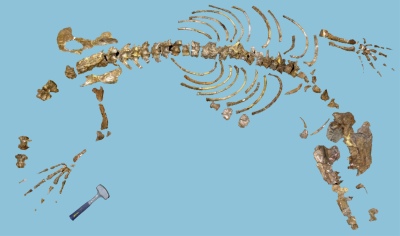
Ambulocetus is not "similarly incomplete" at all. Several fossils are known, including one almost complete skeleton. (Image used with permission; click on the image to go to the source at J.G.M. Thewissen's pages, offsite).
This is part of a beautiful sequence of transitional fossils that have revealed the origin of whales, and have resolved a long standing debate about their relationships to other mammals – another example of how evidence is not just interpreted to fit hopes, but really does serve to confirm some models and falsify others. (Specifically; whales descended from artiodactyls, not from mesonychids.) See our FAQ The Origin of Whales and the Power of Independent Evidence.
Feedback Letter
Response
Feedback Letter
Response
In this case it should be understood that there is no "THE coelacanth", as the term coelacanth actually refers to a whole Order of fishes the Coelacanthini (Actinistia). So saying "THE coelacanth" without specifying that one is referring to one of the still living species, is like referring to "THE primate", "THE carnivore", or "THE rodent" (all different Orders of mammals). In the history of life on Earth there hasn't been just one kind of coelacanth any more that there has been just one kind of primate, carnivore or rodent.
Now, in response to both questioners, it is not true that the two living species of coelacanth (Latimeria chalumnae and L. menadoensis) have remained "completely unchanged" compared to their relatives found most recently in the fossil record (from the Late Cretaceous, some 70 my ago). In fact not only are they different species from those found as fossils they are classified as belonging to completely a different genus than their Cretaceous relatives.
Yes the living genus of coelacanth is remarkably similar in appearance to some of their extinct relatives but they are not identical. For example the genus Macropoma from the Cretaceous belongs to the same Family (Latimeriidae) but is only about a third the size of Latimeria, and there are also a number of other differences in the details of their anatomy. There were probably many genetic, physiological, and even behavioral differences as well but those don't fossilize so it would be difficult for us to know. And although Latimeria is similar to some Cretaceous genera, there are earlier coelacanths that were much less similar in appearance (though still recognizable as belonging to the same Order).
Fossils belonging to the Order Coelacanthini first appear in the fossil record during the Middle Devonian period (about 390 million years ago) and are last found in rocks from the end of the Cretaceous period (about 70 million years ago), however they seemed to have reached their peak of diversity during the Triassic (about 248 to 206 Million Years Ago) (Forey 1998, p. 245). However, despite having been given the colorful moniker of "living fossil", Latimeria (the living genus) is not represented in the fossil record at all.
All that being said it should also be understood that evolutionary theory does not require that a group of organisms (like coelacanths) must change radically over time. If a successful phenotype (shape, physiology, & behavior) is evolved then as long as it remains successful there is no reason it must change.
Regarding the place of the Order Coelacanthini in the evolution of tetrapods (land dwelling vertebrates), few if any paleontologists believe that they are, as a group, ancestral to tetrapods. This distinction goes to the coelacanth's equally lob-finned cousins the osteolepiforms. This makes (extinct) coelacanths more like great, great, great, aunts, than great, great, great, grandmothers to the tetrapods, and living coelacanths distant cousins.
As for Latimeria walking around the sea floor on it's lobe-fins this was a somewhat unfounded speculation by the ichthyologist (J. L. B. Smith) who originally described the genus in 1940 and no one has believe that they do this since they were first observed living in the wild in 1987. However it is interesting to note that the way in which Latimeria rotates it's fins while maintaining a stationary position in the water is somewhat reminiscent of the way tetrapods move their legs while walking.
Links
- Index to Creationist Claims - Claim CB930.1
- Living Fossils: Coelacanths and the Ancestry Debate by Peter Forey
- Coelacanth evolution by P. Z. Myers
- Fish Out of Time
Books
- Thomson, Keith Stewart (1991) Living Fossil: The Story of the Coelacanth
- Forey, Peter L. (1998) History of the Coelacanth Fishes
- Weinberg, Samantha (2000) A Fish Caught in Time: The Search for the Coelacanth
Feedback Letter
I have seen several articles written by him on Creation Science sites and www.trueorigin.org but nothing identifying him or his background. Does anyone know about him or what his credentials are.
Response
Q: What qualifications does Tim Wallace have for addressing the origins issue?
A: The first and foremost is a strong desire to know—and make known—the truth, rather than propaganda put out by anyone on any side of this issue. The second is a brain, the effective use of which has been developed through years of reading and discussing both sides of this issue with parties from both sides.
[For those to whom educational/institutional credentials are important, most of the other contributors to this site provide an abundant supply.]
That is, Tim does not claim any special professional qualifications. He prefers that people focus on the arguments themselves.
We agree. We've never bothered to set up a list of credentials for contributors to talkorigins either (though individual FAQ authors sometimes choose to state their credentials). Credibility does not come from credentials. We're also dubious about the credentials he does claim; but you'll have to judge that for yourself from his own writing.
There are some contributors to Tim's web site who have quite good credentials, and yet they till write articles that are utterly without merit and easily refuted by an amateur who is willing to take the time to check a bit of relevant background.
Feedback Letter
Response
There are many scientists who don't worry about the matter of education in the general community, and focus exclusively on research and on advanced level teaching for those who are training to be scientists. There are other working scientists who spend some time on the task of helping to explain the discoveries of modern science for an interested public.
Welcome aboard. We don't expect or demand that you suddenly change your views; but if you are interested in exploring the matter, we try to give the perspective of conventional science, along with plenty of links to the creationist sites we critique, so that you can compare for yourself.
Feedback Letter
Response
Speaking personally, my bet is much like yours. H. floresiensis is probably no more closely related to the modern inhabitants of Flores than they are to me. That is, they are another hominid species, not H. sapiens. But I'm no expert, and I'm listening to all sides with great interest.
Feedback Letter
Response
That section of the FAQ is part of a list of five Myths and Misconceptions relating to Piltdown. The list includes misconceptions made both by creationists and by evolutionists. In each case, we give a simple statement of the misconception, followed by text explaining why it is wrong.
Our position is that "the Piltdown hoax was a scientific disaster of the first magnitude".
Feedback Letter
Response
My own view is that religion, as a human trait, is an outgrowth of human social dominance behaviours in sedentary agriculture based societies.
Feedback Letter
Yes, Creationism has it's share of hate and intolerance, but so does evolution.
Response
I remain intolerant of intolerance. ☺
Word games aside: I prefer to put the blame for intolerance on individuals. I know some tolerant creationists, and intolerant evolutionists. Looking at your feedback, you have a point. I disagree with our index to creationist claims on point 4 of CA001, where it says "... it [creationism] is founded on religious bigotry". This is misuse of the term bigotry, and it would be better reworded or omitted.
Feedback Letter
Feedback Letter
Thanks for the great site and keep up the good work!
Feedback Letter
Feedback Letter
Response
Our FAQ on The Recession of the Moon and the Age of the Earth-Moon System describes layered sediments that lets us measure lunar tides 650 million years ago. The actual origin of the moon is a fascinating story. Various competing ideas have been proposed, but about fifteen years ago or so one idea emerged as the only one able to account for the evidence. The Moon is accumulated debris left over from a massive collision that took place some 50 million years or so after the Earth's formation. See The origin of the Moon (offsite).
Feedback Letter
Response
Feedback Letter
There must be a word missing or something, three times *what* of Mitochondrial Eve?
Response
Imagine a population of n individuals. The population size for mitochondrial genomes is n/2 (all the women; guys are a dead end and don't count). The population size for X chromosomes is 3n/2 (one for each male, two for each female).
Feedback Letter
You guys rock, please keep it up. I have sent you a donation, I wish I could afford to send you more. Ever think about setting up a monthy payment plan like I have with People For The American Way where I send them $15 month from my VISA automatically?
Just a thought. Peace
Feedback Letter
Response
Feedback Letter
Feedback Letter
There seems to be an apparent contradiction between the above and the definition of a scientific theory as written on your website. You list the two identifying characteristics as 1. It must be falsifiable, and 2. It must make verifiable predictions. Most notably you do not seem to require observation or experiments of the phenomena.
Which definition is true, and why does there seem to be a difference between them?
Thank you for your time!
Response
Indeed, science does not require "direct" observation of a phenomenon. Usually the observations are indirect in some way. As long as your model has implications for the empirical world that we observe, by indirect effects or traces from the past or whatever, that can be a solid basis for prediction and for falsification.
Experiment is a useful way of exploring some kinds of phenomena, but many scientific observations don't really fit what you normally think of as "experiment". The fixation on "experiment" seems to be a popular stereotype, founded on the great success of laboratory based science, but ignoring all the science that is based on field work and passive observation. No serious philosopher of science singles out "experiment" as a requirement; they all use the more general notion of observation, for which experiment is only a part.
The simple answer to your question, frankly, is that in so far as you see a conflict between your definitions and ours, you are wrong. Put more kindly, if you look into the descriptions and definitions of science proposed by philosophers, you may recognize that "observation" and "experiment" cover more than you might previously have thought. A model makes predictions; what checks a prediction is observation.
Frankly, I think the real problem is that science -- as conventionally understood by all the philosophers who attempt to define or describe science -- has been enormously successful in revealing details of the past that conflict with some traditional religious beliefs about prehistory. Various idiosyncratic definitions are proposed to try and deny the validity of any empirical check on claims relating to the past. These so-called definitions have no credibility in the philosophy of science, and serve only to obscure and confuse what science is really about.
Feedback Letter
On your page http://www.talkorigins.org/faqs/fitness/ , you have the sentence:
He programmed the computer to generate random sequences to see if it would ever generate a line from Hamlet: "Methinks it is a weasel."
I think the line from Hamlet should be corrected to "Methinks it is like a weasel", in the light of what follows.
Best wishes Richard Sanford
Response
Feedback Letter
Feedback Letter
Response
However, Mark's view is in complete accord with effectively the entire scientific community. The phrase to which you object occurs in a feedback response by Mark made in Feb 2006. Mark is speaking of a general "anti-science" attitude of the Discovery Institute that goes well beyond mere cluelessness in biology. He says:
"…the anti-science attitude that goes with it carries over to other areas where good science is essential to saving lives. I was thinking in particular of HIV denial and denial of climate change, but anti-science interferes in other areas, too."
He's right. Climate change denial and HIV denial are both riddled with the kind of anti-science sophistry that plagues the intelligent design movement and creationism generally.
As is normal in science, there is a ferment of debate and dispute over many details. This debate all takes place within a broad consensus that climate change is real, and that human activity is a major contributing factor. Alongside this, there is a strong anti-science denial going on, with refusal to acknowledge that there is anything particularly unusual in current rates of change, or denial of the close link between climate change and human activity.
This is an institutionalized and actively fostered ignorance that has clear potential for harm. Mark's comments are no more than what you should expect from someone who is in touch with the subject. For example, the Royal Society says:
There is an international scientific consensus that increasing levels of man-made greenhouse gases are leading to global climate change.
Similar statements will be found from the combined national science academies of G8 nations, plus Brazil, India and Russia, the AAAS, the NAS, the IPCC, and many other leading scientific organizations. So we're in good company.
Climate-change denial has a lot more in common with creationism than you might like to admit.
Feedback Letter
Did Darwin invent Natural Selection?
Response
As natural selection acts by competition, it adapts the inhabitants of each country only in relation to the degree of perfection of their associates; so that we need feel no surprise at the inhabitants of any one country, although on the ordinary view supposed to have been specially created and adapted for that country, being beaten and supplanted by the naturalised productions from another land. Nor ought we to marvel if all the contrivances in nature be not, as far as we can judge, absolutely perfect; and if some of them be abhorrent to our ideas of fitness.
and in the Descent he says
at every stage in the process of modification, all the individuals which were in any way better fitted for their conditions of life, though in different degrees, would have survived in greater numbers than the less well-fitted.
The term "fitness" as a technical term of evolution comes later. Initially, Ronald Aylmer Fisher, in his groundbreaking (and occasionally objectionable!) book that mathematised evolution, used the term "reproductive investment". This was defined as "fitness" [JStor link - needs a subscription] by J. B. S. Haldane.
Fundamentally, fitness is either absolute - the ratio of genotypes from one generation to another - or relative - the average number of genotypes in a population relative to other genotypes, after reproduction. In both cases fitness measures the rate at which one genotype spreads through a population over time.
Darwin did not invent the idea of natural selection, but he was the first to see it as a motivator of change. See the Darwin's precursors and influences FAQ for details.
Feedback Letter
Response
Darwin started his argument with a distinction between selection in artificial cases, such as animal husbandry, and selection in "nature". This is the reason why "Natural selection" is a class of selection in most peoples' view. I think the distinction itself is artificial...
Feedback Letter
Sincerly,
James Hufnagel
Response
Feedback Letter
Response
Feedback Letter
Feedback Letter
Response
Feedback Letter
Response
As to the origin of life, Darwin had nearly nothing to say nor does the validity of his theory rest on the exact nature of the origin of life. The "lighning bolt struck a pond" is a mishmash of a comment Darwin made in a century (plus) old letter, and the well established and widely replicated production of organic molecules in the Miller/Urey experiment.
Secondly, TalkOrigins is quite unlike creationist organizations by actually linking opposing websites. There are also dozens of links to creationist sites and publications in the individual articles making up the archive. You obviously have not looked carefully at the site, and I invite you to do so.
Finally, there are a goodly number of articles here on the use of various dating methods. You can use them to look for those errors you think are so prevalent.
Feedback Letter
Response
Feedback Letter
-bitter
Feedback Letter
Response
- Almost none of the bird intermediates mentioned are hoaxes.
There is one well known hoax, Archaeoraptor, where a popular
magazine (National Geographic) rushed into publication without
waiting for a proper scientific check, and this fell apart almost
immediately. This one hoax had effectively no impact on science.
It was exposed almost as soon as it was published, and it was
never published in scientific literature. (It failed to pass peer
review twice before NG rashly went ahead with their article.)
That's it. There are no other hoaxes of any significance.
By the way; there is a crying need for a good FAQ on the evolution of birds in this archive. There is a brief mention in the transitional fossils FAQ; but it is way out of date. Since it was written there has been a host of new evidence of undoubted authenticity bearing upon birds and theropod dinosaurs. - There are heaps of intermediates between
mammals and reptiles. It is one of the best documented
transitions in the fossil record.
- Your comments on Neanderthals are weird. No; they have not
been proved fully human in the sense of being fully Homo
sapiens. They represent a distinct human species or
subspecies; now extinct. They are far outside the range of
diversity seen within the one human species now living on Earth.
Their skulls in particular have characteristic differences. See
our FAQ Creationist Arguments:
Neandertals.
- Evolution and other natural processes routinely produce new
information. See Apolipoprotein AI
Mutations and Information; and a more technical look at
Information Theory
and Creationism.
- You are ludicrously wrong about similarities of frog,
chimpanzee and human DNA. The DNA difference between us and
chimpanzees depends on how you measure it, but sequence
similarity in coding DNA seems to be less than 1% difference.
They are really close. The differences with frogs are far
greater; way above the 3% you cite.
- As for differences with "the most basic form of life"; if you
mean differences from a primitive common ancestor, then it is a
prediction of evolution that all living organisms should
be equally far removed, in the sense of having evolved for the
same amount of time since then.
- Dating methods do not simply "assume" a closed system. Some
dating methods don't require that assumption, like the
concordia-discordia methods, and others test for it. See Radiometric
Dating.
- You're badly confused about Polonium as well. It is extremely
rare in nature; found only as trace amounts in Uranium ore, in
ratios of around 100 micrograms to the metric ton. This ratio is
about 1 to 10000000000; pretty much the same ratio as their decay
rates. In other words; exactly what we should expect.
- The fossilized cells from a T-Rex are exciting, and there is even evidence that some proteins may have been preserved. No DNA has been detected. There is nothing that conflicts with the age of the fossil. See Dino Blood Redux.
Feedback Letter
At present I’m into the history of mathematics and its applications, and here is one definitely malign influence of a philosopher, in that Gauss decided not to make public his discoveries in non-Euclidean geometry, to avoid disputes with the ‘Boeotian’ followers of Kant, whose philosophy took Euclidean geometry as its very basis. Still, Riemann came along in plenty of time for the necessary mathematics to be available to Einstein for his General Theory of Relativity.
Finally, in no way do I confuse teleological explanations with accounts of how things happened. But here’s one for you all to enjoy – why did God create Darwin? With the Anglican Establishment dominating the later Paley-O-Zoic, and after centuries of God’s name being taken in vain by being used as an instrument of the social order, He raised up Darwin to pull the rug from under their feet.
Response
The problem of historical imagination when trying to understand someone in their own context is large. I think it requires that you set aside everything you "know" from later interpretations and just read the author as if you had just met them for the first time in that time and place. For that reason, I have suggested that Aristotle is actually not using technical terms most of the time, just ordinary words that became technical terms later on. Read him as a "common sense" philosopher, and you get a much better opinion of him.
Feedback Letter
you dong give any profe
was made, my response is:
----------------------------------- profe is fo mafs and alkerol.
Feedback Letter
My compliments to Richard Wein for his article Not a Free Lunch but a Box of Chocolate, in which he criticises William Dembski's book No Free Lunch and Edward E. Max for his article Plagiarized Errors and Molecular Genetics.
The final article in the Wein-Dembski interchange is The Fantasy Life of Richard Wein: A Response to a Response, in which Dembski mentions a case, where a Bell Labs physicist published apparently the same research results twice though claiming they were from different experiments. A case of self-plagiarization? For Dembski the verdict is: Intelligent Design!
There is specified complexity: the first publication is the specification for the second, and results data had a random component with a very low probability to reoccur by chance, so there is complexity.
What's funny is (at least to me), that Edward E. Max in his article mentions two cases where publishers were accused of plagiarizing books from other publishers, not of doing "intelligent design", though the argumentation was the same: the reoccurence of exactly the same, supposedly random, errors.
With a design inference method à la William Dembski's, there is no difference between design and plagiarism, so anything can be called designed - all we need is that we have seen the same thing somewhere before!
- Poul Willy Eriksen
Feedback Letter
I had previously given Creationists the benefit of the doubt, but now I know better. Science, as represented by Mr. Hurd, has spoken and shown me the error of my ways. Thank you for setting the record straight.
Response
One other fellow thought that I was too harsh. On reflection I agree. I should not have dragged in used car salesmen.
One may (and I often do) encounter creationists who are merely terribly ignorant. On a very abstract level they are not lying, they are merely repeating lies. However, it is my invariable experience that these ignoramuses will persist in their ignorance regardless of the evidence presented to them. They will also spout many Bible verses that they do not understand either.
Then they are liars too.
As noted by Thomas Aquinas in his Summa Theologica
"In discussing questions of this kind two rules are to be observed, as Augustine teaches. The first is, to hold to the truth of Scripture without wavering. The second is that since Holy Scripture can be explained in a multiplicity of senses, one should adhere to a particular explanation only in such measure as to be ready to abandon it if it be proved with certainty to be false, lest Holy Scripture be exposed to the ridicule of unbelievers, and obstacles be placed to their believing."
Feedback Letter
Why are there no land based snakes in New Zealand?. There are snakes all over Australia and Tasmania, and NZ is not that far away.
There have been fossil finds of snakes in NZ dated to around 15-20 million years ago, so the idea that they never got there is a bit damaged by this. And why did they die out?
I would have thought that given the huge number of birds, and given how much many snakes like bird's eggs for breakfast, that this would have been a plus for survival.
Of course, the opposite could be true, and Moas in particular might have enjoyed snake fr dinner.
As I said on IIDB, I have been close to stepping on a tiger snake several times in a fairly built up area, so the subject is of genuine interest. Have any studies been done at all? Why Australia, Papaua, New Guinea, Indonesia, and not just over the creek in NZ?
There is nothing here on the subject, nor can I find anything on any other web site.
Is there an answer, or is it just something that nobody has studied,or even (seriously) speculated on.
THanks, if you respond, and thanks for a great website.
Norm
Response
It turns out that certain freshwater fish have palatal tooth-bearing elements that, if broken in a certain way, are practically indistinguishable from fragments of snake pterygoid bones broken in a certain other way. The tooth morphology and attachment is remarkably convergent, but the teeth in the fish are relatively enormous, so remains of a tiddler can be seen as evidence of a giant snake.
The suspicious fact (the dog that didn't bark, if anyone knows their Holmes) was the absence of any snake vertebrae from the same deposit.
New Zealand still has no snakes.
Feedback Letter
Response
Feedback Letter
Response
It is true that Europeans have longer and thicker hair on their body than Africans usually do. This is not because they have more hair, but because their hair growth has been turned up a bit. As it happens, we have roughly the same number of hairs per square inch as all humans, and in fact as all apes. Europeans and Asians are a derived form of human variation. The ancestral modern humans are African, although there has been a lot of genetic traffic to and fro.
The idea that Africans are more "apelike" in fact comes from well before evolution was developed in biology. The older idea of the Great Chain of Being supposed that organisms were arranged on a scale from simple to complex, and in the 18th century, this was used to justify European domination over the slaves they were taking from Africa. "Negroes" were placed between Europeans and apes, and treated as children or work animals. Some people after Darwin combined this scale with evolutionary change to imply that "Negroes" were not "as evolved" as Europeans, and hence to justify paternalistic policies of control. It was not, in itself, a conclusion of evolution but of prior ideas that were forced into an evolutionary worldview.
Why that prejudice survives is due to social attitudes that have a deep history in western thought.
And evolution hasn't stopped, either among Africans or anyone else. We are constantly evolving, to meet new environmental challenges, including our use of dairy animals, exposure to diseases and industrial pollutants, and so forth. I hope this helps.
Feedback Letter
My name is Nathan Powell. I am 16 y.o., and am a Creationist. I just have a quick question. Maybe I am missing something here, but it seems to me that you don't need to worry about the dinosaurs living with man controversy, because the coelacanth is still alive today, and some of them supposedly evolved into amphibians 300-350 million years ago. So since this is true why are you trying to disprove dinosaurs ever lived with man? Thanks!
Sincerely, Nathan Powell
Response
If creationists (young Earth) were simply claiming that a population of non-avian dinosaurs had survived into historical times (roughly the last 9,000 years) or even to the present that would not be a problem for evolution at all. Evolutionary theory does not mandate that any group of organisms must becomes extinct, and as you note, there are other organisms, like the coelacanths, that were once thought extinct but turned out to still have living representatives. In the case of dinosaurs, they have been with us all along (though we didn't understand this until fairly recently) in the form of birds.
But this is not what creationists are arguing. What they are actually trying to prove is that (non-avian) dinosaurs and humans have in fact coexisted throughout the entirety of earth history, which they believe is restricted to the last 6 to 10 thousand years. This claim if it could be substantiated (and it hasn't been) would be problematical for not only evolutionary theory but all of modern science.
See the following from the Index to Creationist Claims for more on some of the claims of antievolutionists regarding this issue:
- CB930. Some fossil species are still living.
- CB930.2. A plesiosaur was found by a Japanese trawler.*
- CB930.3. Dinosaurs may still be alive in the Congo.
- CB930.4. A pterodactyl was found alive in Jurassic limestone.*
- CC101. Human footprints have been found with dinosaur tracks at Paluxy.
- CC120. Baugh found a fossilized finger from the Cretaceous.
- CC130. A petrified hammer was found in Cretaceous rocks.
*Note: Even though plesiosaurs and pterosaurs are not dinosaurs they were Mesozoic contemporaries of the dinosaurs and creationists make the same sorts of arguments regarding them.
Feedback Letter
Thanks to sites like yours and a few books, I now realize that YEC is false, even though some of us would love to believe otherwise.
Thank you for investing the time to create such an outstanding site. Now that I realize how overwhelming the evidence for evolution and an old earth is, I marvel that you have the patience to explain it. I am embarrassed by my own former ignorance, and grateful to you and others for taking the time to educate me.
I implore my fellow Christians to remember that all truth is God’s truth, and to seek truth with humility. We are only human, and are therefore prone to self-deception and dishonesty when listen only to our own little group. Scientists – both believing and unbelieving – have much to teach us if we will listen.
Feedback Letter
Agnostic Aussie philosopher: Neo-Darwinism's Failings
Judging by her summaries, his arguments sound (only superficially, of course) convincing and a firm rebuttal, or list of links, might be of use to anyone unfortunate enough to be tempted to accept them.
Thanks for all your great work!
Response
Then I will need to write a rebuttal (which nobody pays for) and then wonder if it was at all worth the effort. This is why few people of sound mind take on this sort of work. But I did have the great pleasure of having something I wrote cited in the Dover Pandas Trail, and even in the decision written by Judge Jones.
So, I feel that the effort is worth it after all. Others, who contribute to TalkOrigins and TalkDesign and our other associates, have had simillar pleasures. The anti-science sites we also link are living examples that the Dark Ages are only a moment away.
Thanks for the heads-up.
Feedback Letter
ps. evolution as a process is no way a challenge to God or Religion or spiritual belief. One's spritual understanding goes through evolution during one's lifetime, too. As Grendel said, 'Things change and alternatives exclude.'
Response
On the point about spirituality, it is true that evolution doesn't challenge religious belief, and the majority of religious denominations accept that. See the God and Evolution FAQ, and the list of religious bodies that accept evolution at the NCSE site. But the fact of evolution challenges some claims made by scriptural literalists who (arbitrarily) treat some passages of the Bible or other scriptures as literal history or cosmologies.